






When purchasing a used vehicle, ordering precise replacement components, or verifying factory safety updates, relying on guesswork can lead to costly mistakes. For Mazda owners and perspective buyers, the solution to verifying a vehicle’s exact identity lies within its Vehicle Identification Number (VIN). Far from being a random string of characters, this 17-digit code serves as your vehicle’s unique digital fingerprint.
By utilizing a Mazda VIN decoder, you can unlock an abundance of factory-direct data. This guide will walk you through how to manually decode a Mazda VIN number, where to locate your car’s hidden serial stamps, and how to leverage this information to protect your automotive investments.
The Alphanumeric Blueprint: How to Decode Mazda VIN Numbers Manually
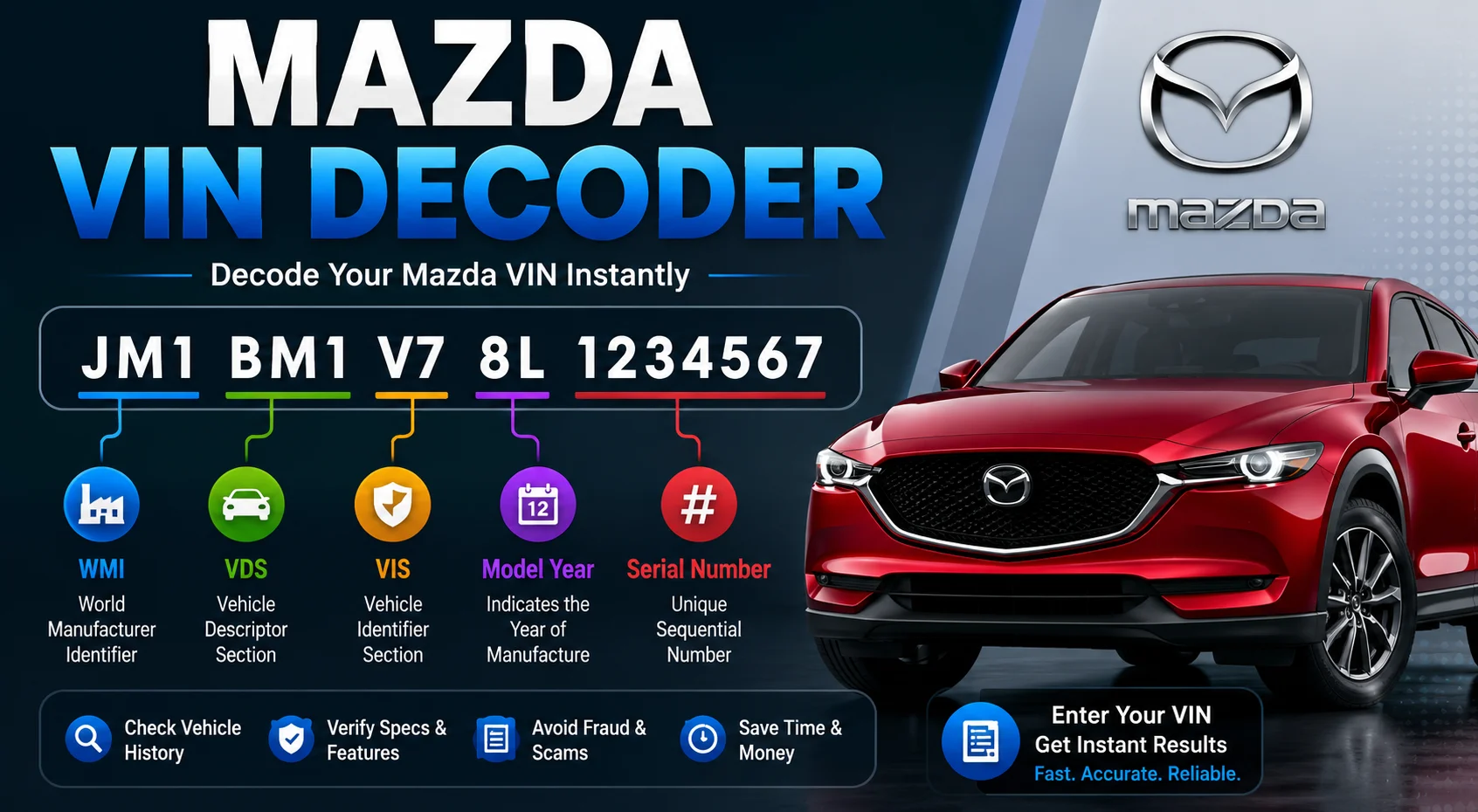
Modern vehicle manufacturing protocols dictate a highly structured framework for serial identifiers. Since 1981, global automotive markets have adhered to a standardized 17-character VIN sequence regulated by the International Organization for Standardization (ISO).
A standard Mazda VIN is structurally split into three core categories: the World Manufacturer Identifier (WMI), the Vehicle Descriptor Section (VDS), and the Vehicle Identifier Section (VIS).
| VIN Position | Section Type | What It Decodes | Common Mazda Examples & Variations |
| Digits 1–3 | WMI | Country of Origin & Factory Division | JM1 (Japan, Mazda passenger cars); JM2 (Japan, trucks/MPVs); 4F2 (USA, Mazda/Ford joint plant) |
| Digits 4–8 | VDS | Body Style, Platform Model, & Engine Type | Platform lines like BP (Mazda3), DK (CX-3), or KF (CX-5); details on SkyActiv-G/D displacement |
| Digit 9 | Check Digit | Mathematical Security Algorithm Verification | A calculated single digit or X used by computers to validate that the VIN is genuine and unedited |
| Digit 10 | VIS (Year) | Official Model Year Designation | Global standard codes (e.g., S = 1995, A = 2010, G = 2016, T = 2026) |
| Digit 11 | VIS (Plant) | Exact Assembly Plant Location | 0 (Hiroshima, Japan Plant); 1 (Hofu, Japan Plant); K (Augusta, USA Plant) |
| Digits 12–17 | VIS (Serial) | Unique Sequential Production Number | The exact numeric sequence tracking its position on the factory floor assembly line |
Unpacking the Core Segments
Understanding these sections gives you deeper insight into your car’s heritage:
- The Origin Check (Positions 1-3): Mazda builds the vast majority of its performance assets directly in Japan. If your string begins with
JM1, your vehicle rolled out of a Japanese port. Domestic joint ventures, like vehicles co-developed with Ford or built at the newer Alabama facilities, display regional North American codes. - The Chassis and Motor Matrix (Positions 4-8): This segment tells you exactly what kind of car you have. It details whether the chassis belongs to a subcompact hatchback or a three-row family SUV, alongside markers tracking powertrain configurations like high-compression SkyActiv setups or early rotary layouts.
- The Production Timeline (Positions 10-11): The tenth character represents the model year across the industry. Cross-referencing this against the eleventh character reveals the precise factory floor where your vehicle was assembled.
VIN Finder: Where to Locate Your Mazda’s 17-Digit Serial Number
Before you can run a car vin lookup, you need to extract the physical string from the vehicle. Manufacturers position these plates in areas that are easy to scan but highly resistant to tampering or collision damage.
1. External and Cabin Placement Points
- The Driver’s Side Lower Windshield: Stand outside the vehicle on the driver’s side and look through the bottom corner of the front windshield. The VIN is stamped onto a metal plate secured directly to the dashboard structure.
- The B-Pillar Door Jamb Placard: Open the driver’s door and inspect the inner door frame or latch pillar. You will find a federal safety certification sticker containing inflation metrics, weight capacities, and the master 17-digit VIN printed alongside a scanable barcode.
2. Under-the-Hood Structural Locations
- The Engine Firewall: On older or right-hand-drive models, the chassis number is often stamped directly into the heavy metal firewall partitioning the engine bay from the passenger cabin.
Checking structural metadata components on older vehicles is equally critical if your search spans outside the car ecosystem. For instance, understanding how a motorcycle vin lookup free framework operates or verifying hull numbers is highly recommended before buying alternative marine transport like a used watercraft, ensuring your investment is completely safe and sound before hitting the water.
Why You Should Run a Car VIN Lookup Before Buying a Used Mazda
Skipping a comprehensive vehicle specs by vin number review before purchasing a pre-owned vehicle leaves you vulnerable to hidden issues. Running an automated check protects you in several key areas:
Detecting Vehicle Cloning and Fraud
A growing issue in the used car market is “VIN cloning,” where a stolen or totaled vehicle is given the identity of a clean, identical car. By using a mazda vin decoder, you can instantly cross-reference the factory records (like exterior paint codes, original engine size, and interior trim tier) against the physical vehicle in front of you. If the system states the VIN belongs to a manual, grey Mazda Miata, but you are looking at an automatic, red model, walk away immediately.
Tracking Open Safety Recalls
Manufacturers regularly issue voluntary and federal safety recalls to rectify component oversights. Running a targeted factory search lets you check for unaddressed recall campaigns, such as:
- Faulty high-pressure fuel pump replacements.
- Variable Valve Timing (VVT) component adjustments on older turbocharged motors.
- Airbag control module software updates.
Unearthing hidden mechanical flags protects your investment down the road. Running a deep background review helps flag systemic car issues early on, which is just as important as knowing how to troubleshoot a faulty radiator coolant leak fix before engine complications escalate into an expensive breakdown.
Best Methods and Tools to Look Up Car by VIN Online
When you are ready to process your query, you have several dependable digital options to choose from:
Official Public Portals (Free Specifications)
For a straightforward look at factory specifications without a fee, your best option is the National Highway Traffic Safety Administration (NHTSA) vPIC tool. Backed by federal reporting mandates, this public interface decodes any legal 17-digit chassis number to display its exact manufacturing source, built-in safety features, and original engine displacement details.
Comprehensive Commercial History Tools
If you are finalizing a purchase and need more than just structural specifications, turn to a premium vehicle history aggregator. Services like Carfax or AutoCheck combine factory build data with private and state records to track insurance total-loss filings, title branding history, past auction sales, and odometer readings over the vehicle’s lifespan.
Frequently Asked Questions (FAQ)
Can you determine a Mazda’s exact trim level directly from the VIN?
The VIN specifies the primary engineering parameters, such as the base model platform and engine displacement. However, it does not always indicate optional trim tiers (like distinguishing a Grand Touring from a Signature trim). To find the exact trim level, run the VIN through an official factory parts catalog or an advanced decoding service that accesses the original dealership window sticker records.
Why does my Mazda VIN have fewer than 17 characters?
If your vehicle has a 10- or 11-digit serial number, it was manufactured before 1981. Prior to this date, automotive brands used proprietary serial numbers unique to their own internal factories. For these classic models, you will need to use a specialized vintage Mazda decoder.
Is there a completely free Mazda VIN decoder tool?
Yes. The NHTSA vPIC portal provides a comprehensive breakdown of mechanical specifications, factory origins, and open safety recalls completely free of charge for consumers.