







Seeing a bright neon green, orange, or pink puddle under your car can be alarming. It’s a clear signal that your cooling system has been compromised. However, a coolant leak doesn’t always signal a catastrophic engine failure or an emptying of your savings account. Often, the solution is as simple as tightening a screw or replacing a $20 rubber hose.
Finding the right leaking antifreeze fix quickly is critical. Your engine relies on this fluid to regulate temperature; without it, heat builds up rapidly, warping metal components and leading to total engine seizure. This guide covers everything from finding the source of the drip to understanding the cost to fix antifreeze leak issues, helping you decide whether to tackle it yourself or call a pro.
How to Find Antifreeze Leak Sources
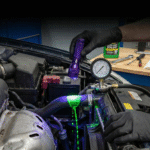
Before you can fix the problem, you must confirm what is leaking. Cars drip various fluids, from clear AC condensation (water) to brown oil.
1. The Visual Check Antifreeze is dyed specifically to distinguish it from other fluids. Look for bright, unnatural colors—typically lime green, orange, pink, or sometimes blue. If the puddle is clear and odorless, it is likely just water from your air conditioner, which is perfectly normal.
2. The Smell Test Antifreeze has a distinct, sweet odor often compared to maple syrup or hot candy. If you smell this while driving or after parking, you likely have a leak, even if you don’t see a puddle yet (it might be burning off on the hot engine block).
Safety First: Protect Your Hands When hunting for a leak, you often need to inspect the radiator fans, belts, and hoses closely. Be aware that electric cooling fans can spin up automatically, even if the ignition is off. Before reaching your hands into tight engine spaces, you should know how to disconnect car battery terminals. Cutting the power ensures the fan blades won’t activate unexpectedly, protecting your fingers from serious injury.
Simple DIY Leaking Antifreeze Fixes
If you are handy with basic tools, you can often perform an antifreeze leak fix in your own driveway.
Tighten the Clamps The most common and cheapest culprit is a loose hose clamp. As rubber hoses age, they compress, and the metal clamps holding them can lose their grip.
- The Fix: Use a screwdriver to tighten the worm-gear clamps connecting the radiator hoses to the engine. If the clamp is rusted, replace it.
Replace “Squishy” Hoses Squeeze the upper and lower radiator hoses. They should feel firm but flexible. If a hose feels rock-hard, crunchy, or overly soft and squishy, it is deteriorating internally.
- The Fix: Drain the coolant, remove the clamps, and swap out the hose. This is a standard maintenance task that answers the common query of how to fix antifreeze leak for under $50.
Liquid Sealants (Stop-Leak) For pinhole leaks in the radiator fins, a liquid sealant can be a temporary solution. You pour it into the radiator, and it hardens upon contact with the air at the leak site. Warning: Use these sparingly. Overuse can clog your heater core and water pump, causing more expensive damage down the road.
Cost to Fix Antifreeze Leak: What to Expect
Financial anxiety is a major factor when a car breaks down, with thousands of users searching for the cost to fix antifreeze leak every month. The price varies wildly depending on what is leaking.
Estimated Repair Costs:
- DIY Hose Replacement: $20 – $60 (Parts only).
- Thermostat Housing Gasket: $100 – $250 (mostly labor).
- Water Pump Replacement: $300 – $800. The pump is often buried deep in the engine, requiring significant labor hours to access.
- Radiator Replacement: $400 – $900. If the plastic tanks on the side of your radiator are cracked, the entire unit usually needs to be swapped.
According to search data, many users specifically ask how much does it cost to fix antifreeze leak to budget for these repairs. Generally, expect labor to make up 60-70% of a professional bill.
The “Invisible” Leak: Internal Engine Damage
Sometimes, you will find your coolant reservoir is constantly empty, yet there is no puddle on the ground. This is the “nightmare scenario” where the leak is internal—usually a blown head gasket.
When a head gasket fails, coolant is sucked into the engine cylinders and burned along with the gasoline.
- Symptoms: You may see thick white smoke coming from your tailpipe, or your engine oil may look milky and frothy (like a chocolate milkshake).
- Performance Issues: Coolant in the combustion chamber dampens the explosion that powers the car, leading to misfires. If you are noticing low coolant levels and asking why is my car shaking at red lights or idling roughly, your “leak” has likely evolved into a major internal mechanical failure.
Conclusion
Ignoring a coolant leak is a gamble you will eventually lose. Whether it is a simple $5 clamp or a $500 water pump, the cost to fix antifreeze leak issues is always cheaper than replacing a seized engine. Start with a visual inspection, check your hoses, and if the fix is beyond your toolkit, get to a mechanic immediately. Keeping that green fluid inside the engine is the only way to keep your car on the road.