





TL;DR: Exterior paint typically wears faster at higher elevations than it does at sea level. Summit County’s elevation, stronger UV exposure, low humidity, and frequent temperature changes all affect how paint is applied and how long it lasts. Understanding these conditions helps homeowners choose appropriate products, schedule painting at the right time, and set realistic maintenance expectations.
Exterior paint is designed to protect a home’s siding from moisture, sunlight, and seasonal weather. In mountain communities such as Breckenridge, Frisco, Dillon, and Keystone, that protection is tested under different conditions than in lower-elevation areas. At elevations between approximately 8,500 and 11,000 feet, stronger ultraviolet radiation, lower humidity, and larger day-to-night temperature swings place additional stress on painted surfaces.
These conditions affect both application and long-term performance. Paint that dries too quickly may not cure as intended, while prolonged UV exposure can accelerate fading, chalking, and surface breakdown. As a result, the expected lifespan of an exterior paint system may be shorter than manufacturer estimates developed under more moderate environmental conditions.
When comparing a Painting Contractor Summit County, homeowners should ask about experience working in high-altitude environments, recommended products for mountain climates, and the timing of the project. Straightline Painting serves Summit County properties where these conditions are part of everyday project planning, but the same questions are worth asking any contractor before exterior painting begins.
Understanding how climate influences paint performance helps homeowners make informed decisions about preparation, product selection, and long-term maintenance.
What UV Radiation Does to Exterior Paint at Altitude
UV radiation breaks the molecular bonds of paint binders and pigments. The process is called photodegradation and produces visible fading, chalking, and cracking in the paint film over time. At 10,000 feet, every 1,000-foot elevation gain adds approximately 4% more UV intensity. The cumulative effect is roughly 40% more UV exposure than at sea level.
This elevated UV load accelerates two specific failure mechanisms. The acrylic binder that holds pigment to the substrate loses flexibility as UV breaks down its polymer chains. The binder becomes brittle, cannot accommodate thermal movement, and develops micro-cracks. Those cracks allow moisture to enter, which accelerates further failure.
Organic pigments (particularly reds, blues, and some yellows) degrade under UV faster than inorganic pigments (titanium dioxide whites, iron oxide earth tones). A property painted in a saturated red or blue at Summit County elevation will fade measurably faster than the same product used at sea level.
UV-stabilizing additives in premium paint products absorb UV energy before it reaches the pigment molecules, slowing photodegradation. Looking for a paint product with documented UV resistance ratings in the product data sheet, typically listed under color retention or UV stability, identifies which products are formulated for high-altitude performance.
What Low Humidity Does to Paint Application in Summit County
Summit County’s average relative humidity frequently drops below 20% during summer days. Water-based acrylic paints cure through a process called coalescence, where water evaporates from the film and the acrylic polymers fuse together to form a continuous, protective layer.
When ambient humidity is below 20%, the water in the paint film evaporates faster than the coalescence process can complete. The surface skins over while the interior of the film is still wet. This is called flash-drying, and it produces a paint film that looks correct on the surface but has poor adhesion and reduced film integrity below the skin.
A paint job applied under flash-drying conditions typically shows peeling within one to two seasons because the adhesion bond to the substrate is weaker than a properly cured film.
The practical fix is to apply paint in the early morning hours when humidity is higher and temperatures are cooler. In Summit County, this typically means starting by 7 a.m. and completing the application by noon before afternoon temperatures peak and humidity drops further.
What Temperature Swings Do to Paint Films
Summit County properties experience temperature changes of 40 to 60 degrees Fahrenheit within a single day during the shoulder seasons. April and September can drop from 65 degrees in the afternoon to below freezing overnight. Paint films expand and contract with temperature.
A paint film without adequate flexibility for these swings develops cracking at the stress points, particularly around fasteners, window frames, and trim intersections where different materials meet with different expansion rates. These cracks allow moisture to enter before the next painting cycle.
Elastomeric paints and premium 100% acrylic formulas with elongation ratings above 100% are appropriate for Summit County properties because they can stretch with thermal movement without cracking. Standard exterior paints typically rate at 50 to 100% elongation. Elastomeric formulas reach 200 to 300%.
What Film Thickness Matters More at Altitude
Paint protection depends on the thickness and integrity of the dried film. At high UV exposure, a thicker film resists photodegradation longer than a thin film of the same product because there is more material between the UV energy and the substrate.
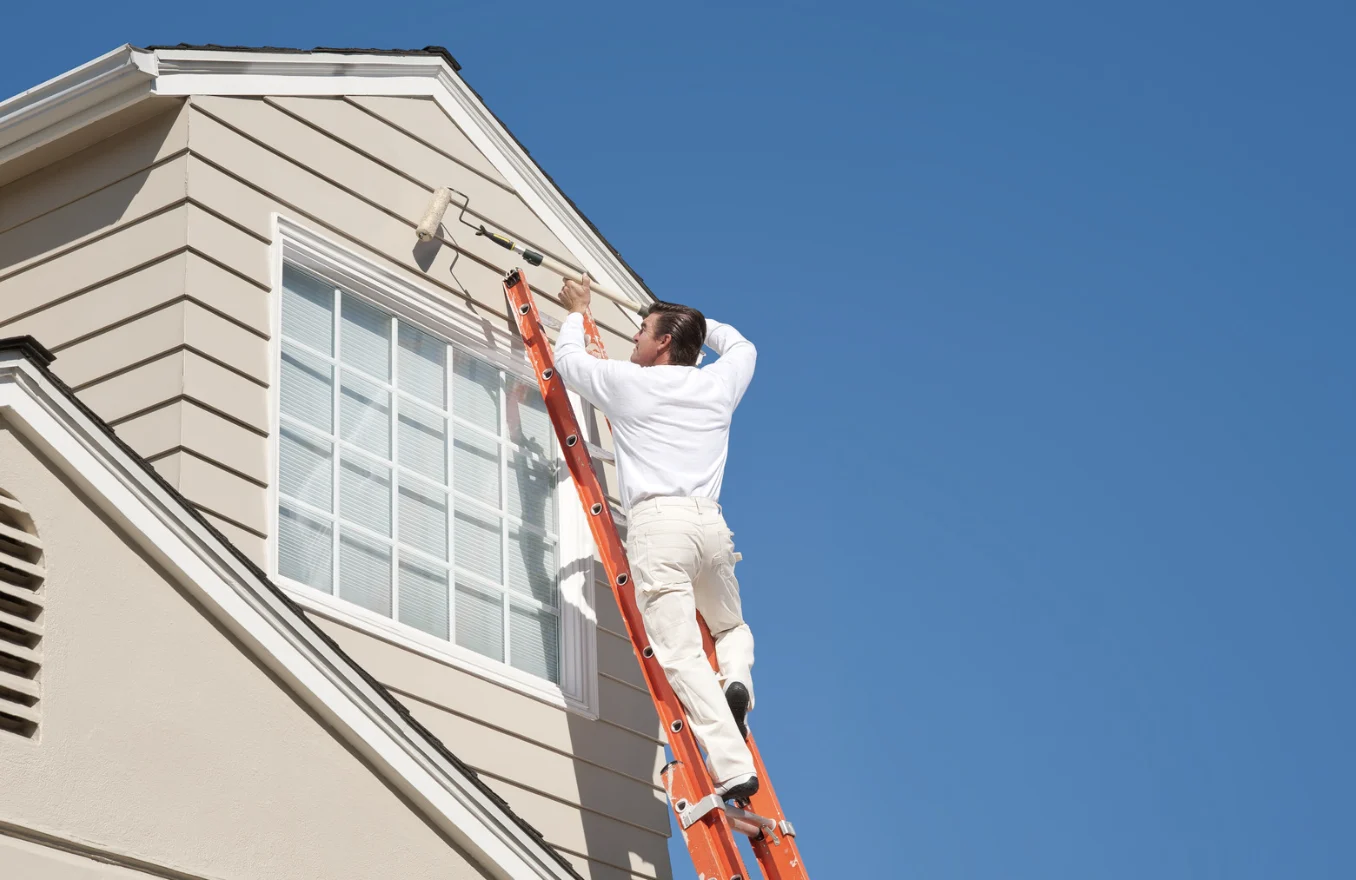
Two full coats at the manufacturer’s recommended spread rate are the minimum for Summit County properties. South and west-facing elevations that receive the most direct sun benefit from three coats on the most exposed surfaces.
A painting contractor working at altitude who applies one coat on a tight schedule is producing a film that will fail faster than a properly applied two-coat system, regardless of the product quality.
What Products Perform Best at Summit County Elevation
For wood siding and trim, a high-quality 100% acrylic exterior paint is generally recommended. At higher elevations, products designed to resist ultraviolet exposure and accommodate seasonal movement in wood tend to provide better long-term performance than standard exterior coatings. Product selection should also follow the siding manufacturer’s recommendations and the conditions of the existing surface.
For log homes and rough-hewn wood common in Summit County mountain architecture, a penetrating oil or oil-alkyd hybrid is more appropriate than film-forming latex because it penetrates into the wood rather than forming a film that is vulnerable to peeling when the wood grain opens.
For stucco and concrete, elastomeric coatings provide both UV resistance and crack-bridging flexibility that standard latex cannot provide on these substrates.
Key Takeaways
- UV radiation at 10,000 feet is approximately 50% higher than at sea level, accelerating exterior paint failure by 2 to 5 years compared to manufacturer data sheet estimates developed at lower elevation
- Flash-drying under Summit County’s low humidity conditions produces paint films that look correct on the surface but have weak adhesion below the skin and fail within one to two seasons
- South and west-facing elevations receive the most direct UV exposure and benefit from three coats of premium 100% acrylic rather than the standard two-coat specification
- Elastomeric coatings with elongation ratings of 200 to 300% accommodate the 40 to 60 degree daily temperature swings in Summit County without cracking at stress points
- Application timing matters significantly at altitude; early morning starts before 7 a.m. take advantage of higher humidity and lower temperatures that allow proper coalescence before the film skins over
- Penetrating oil finishes are the appropriate product for log home construction common in Summit County because they penetrate wood grain rather than forming a surface film that peels when the grain moves
Altitude changes the rules for exterior painting in ways that products used at sea level do not address automatically. Specifying the right product for the right surface and applying it under the right conditions produces paint jobs that hold up in Summit County’s environment rather than ones that require early attention.