






Introduction
A lot has changed in modern manufacturing over the years. Nowadays, machines are smarter, faster and more accurate than ever. One of the major contributing factors to this change is G-code. If not, CNC machines would have no way to function. They would have no idea of where to go, how quickly to slice, or what direction.
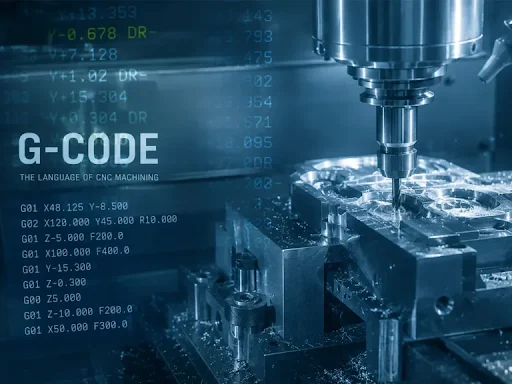
Machines work by reading G-code. It is used in nearly all CNC machines today. Here you will be able to learn about the G code, how it works, types of G code, and its uses.
What is G-code?
What is G-code? A programming language that can be used for CNC machines. In this language, machines are provided with instructions. These instructions enable the machine to determine the speed with which it should be cut and to what path it should follow.
G-code is created by CAM (Computer-Aided Manufacturing) software. The process begins with designing a part in the CAD software. That design is then translated to G-code. This code is fed into the machine and the machine performs the steps.
There are two parts to a G-code: the lines of G-code and the parameters of G-code. A command line looks like this:
G01 X50 Y25 F100
The words of this line have different meanings. G01 is a straight line motion command to the machine. The coordinates in which the tool wants to move are (X50, Y25). The feed rate is set by F100, which is the speed at which the tool moves. These instructions combine to move the machine very precisely.
How Does G-code Work?
G-code operates very simply and effectively. The first step is for a designer to create a 3D model using CAD software. This model represents the form of the part. This model is then read into CAM software and converted to a G-code file. All the command lines a machine needs are in this file.
The machine then reads these lines one by one. Performs instructions sequentially. This feature enables the machine to make precise cuts, holes, or forms in the materials. Even slight mistakes in the G-code can cause poor results. This is why it is important that the CAD design and the G-code are both accurate.
Types of G-code
G-code can be of various forms. These are all responsible for a different aspect of the machining process.
Motion G-codes specify the movements of the cutting tool. G00 is a rapid movement without a cutting operation. Straight-line cutting is performed using the G01 command. The circular movement, clockwise and counterclockwise, is performed by G02 and G03.
Positioning G-codes: How the machine follows the tool’s location is determined by positioning G-codes. In G90, all coordinates are absolute; that is, they are measured from a fixed point. G91 incremental positioning will be used, in which case each movement will be made from the previous position.
Unit Setting G-codes: It provides instructions to the machine on how to use a measurement system. G20 will set units to inches. G21 measures in millimeters. If the wrong size is indicated, the machine may cut the wrong size.
Machine Control G-codes: They are used for machine control, not for tool path control. G28 command returns the tool to the home position. G17, G18, and G19 determine the XY plane, XZ plane, and YZ plane the machine operates in.
Tool Compensation G-codes: They work well with tools that are slightly smaller or larger than the specified size. G41 is set up to compensate on the left side of the tool. Compensation is provided on the right at G42. In G40, compensation is completely turned off.
Every type has its own importance. These two features combined provide the machine with all of the necessary data to create an accurate part.
Function and Importance of G-code
The language that drives the precision of CNC machines is G-code. If it didn’t have it, the machine would have no direction. It would not be able to tell where to make the cut or how quickly to move.
G codes tell the CNC machines the following instructions:
- This is the choice as to where the cutting tool will be moved.
- The speed at which the tool should move
- Where to go and in what direction
- What to do with each step.
The accuracy at this level enables the production of complex shapes with close tolerances. The tool will move in multiple axes. It can move along curves, make holes and change operations according to the G-code instructions. G-code also eliminates the need for manual control.
The machine is programmed once by the operator, and the same operations are repeated each time. This will save time and prevent errors. The final portion is similar to the original CAD design.
Uses of G-code
G-code is used in a number of industries and on a variety of machines. It’s an important factor in the CNC Machining Service for Prototype Parts. Prototypes must be accurate on the first try, and G-code can help achieve this. It also feeds 3D printers, in which the machine layers parts onto itself in accordance with the instructions on the G-code generated from a sliced CAD model.
These are the major machines that utilize G-code:
- CNC Milling Machines
- CNC Turning (Lathe) Machines
- CNC Drilling Machines
- CNC Grinding Machines
- 3D Printers (FDM type)
- Laser Cutting Machines
- Plasma Cutting Machines
- EDM Machines
- Waterjet Cutting Machines
In all these instances, the machine can operate with speed and accuracy by using G-code. G-code-driven machines are used daily in industries such as aerospace, automotive, medical, and electronics.
Conclusion
G-code is an important aspect of state-of-the-art manufacturing. It is the language that CNC machines use to understand their tasks. It instructs them on the direction to go, the speed of the cut, and the path to take. If there’s no G-code, automated and precise machining would not be possible. G-code comes in various forms, with each having a particular purpose. All of the following codes are used together: motion, positioning, unit, machine control, and tool compensation codes.
They provide the machine with a complete set of instructions for creating accurate parts. G code is indispensable from prototyping to full production. It takes the digital design to the real world. By learning about G-code, one can understand how modern precision manufacturing works.