






In the competitive world of modern corporate advertising, a memorable brand mascot can be worth its weight in gold. Companies spend hundreds of millions of dollars trying to find a face that resonates with audiences across generations. Few characters have achieved this level of pop-culture dominance quite like “Jake from State Farm.”
What started as a simple, one-off joke in a late-night commercial back in 2011 has evolved into a multi-million dollar marketing empire. Today, the character is no longer just a guy over the phone selling insurance; he is a massive social media personality who shares the screen with A-list athletes and Hollywood legends. If you have ever watched him during a prime-time football broadcast and wondered, “How much does Jake from State Farm make?”, this guide breaks down his estimated salary, commercial payouts, and the actor’s net worth.
How Much Money Does Jake from State Farm Make?
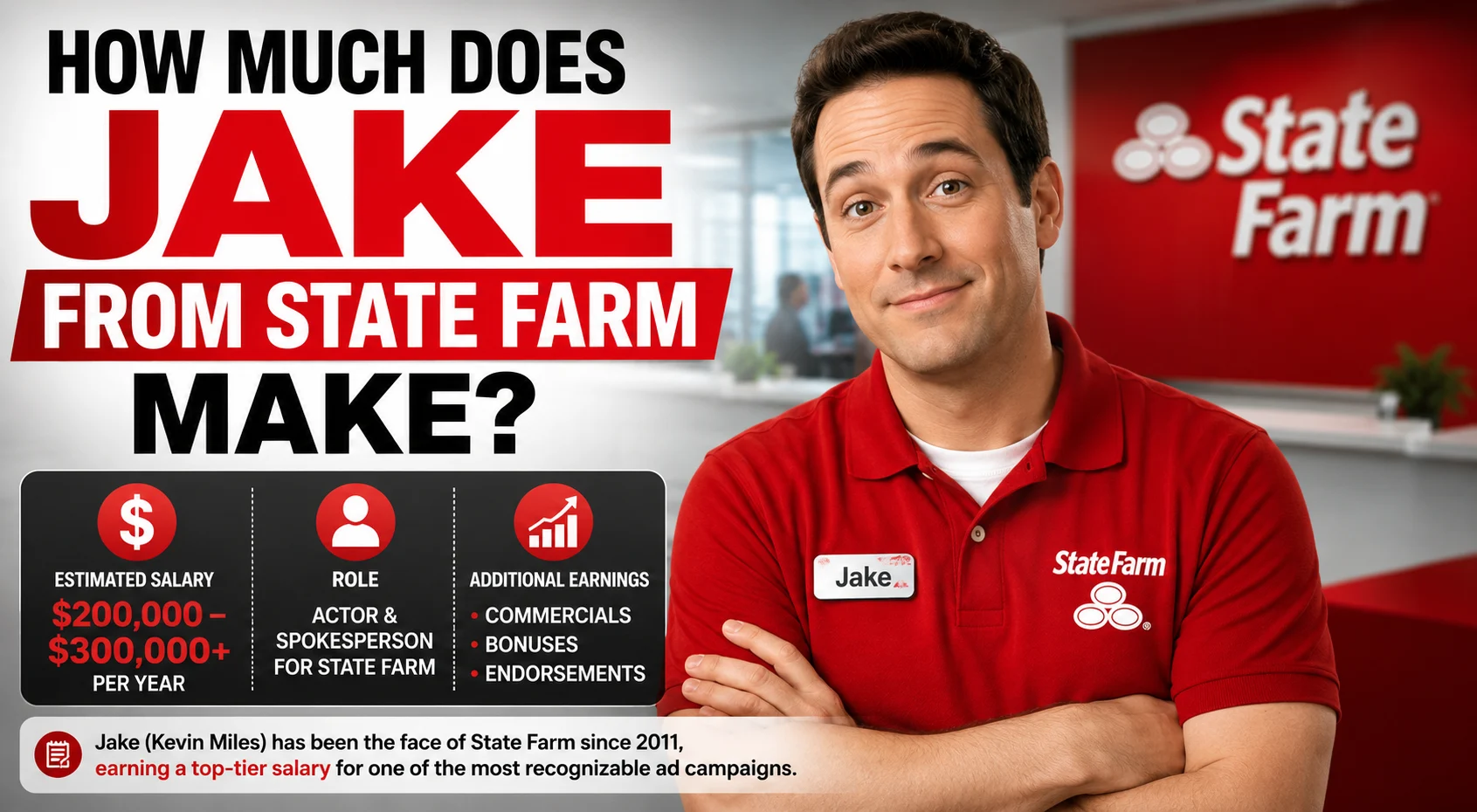
Publicly traded corporations and private talent agencies keep exact contract details strictly confidential. However, industry analysts and entertainment experts estimate that Kevin Miles—the modern actor who plays Jake from State Farm—earns an annual salary of approximately $200,000 to $500,000 baseline from State Farm alone. When factoring in multi-year contract renewals, digital media metrics, and outside Hollywood projects, his annual earnings exceed $1 million to $2 million. Additionally, high-tier commercial actors earn substantial residual payouts every time their advertisements air on national television. Kevin Miles’ overall net worth is estimated to be roughly $5 million to $8.2 million.
The Man in the Red Polo: Who is Kevin Miles?
The inspiring story of the modern “Jake” is a classic example of Hollywood persistence. Born and raised on the South Side of Chicago, Kevin Miles (born Kevin Miles Julian Mimms) discovered his passion for acting in elementary school. He went on to study his craft formally, earning a Bachelor of Fine Arts from the Conservatory of Theater Arts at Webster University.
Like many aspiring actors, his transition to Los Angeles was incredibly difficult. During his first few months in California, Miles could not afford an apartment and was forced to sleep in his car while pursuing auditions.
His life changed permanently in 2020 when he auditioned for State Farm’s massive brand re-launch. Amusingly, Miles actually forgot to wear the mandatory red shirt and khaki pants requested in the audition’s wardrobe briefing. Despite the minor mishap, his on-camera chemistry and natural charm tested incredibly well with focus groups. He landed the job, and within a few months, he went from sleeping in his vehicle to starring in prime-time ad spots alongside global icons like Drake, Arnold Schwarzenegger, and Patrick Mahomes.
Calculating the exact values of these sweeping corporate contracts requires reading through dense legal agreements. These packages feature highly specific marketing clauses, performance milestones, and non-compete rules that can be as complex to decipher as a specialized regulatory manual like the wutawhelp guide online.
Breaking Down the Math: Salary Per Commercial and Residuals
To understand how a commercial mascot generates multi-million dollar wealth, you have to look at how the Screen Actors Guild (SAG-AFTRA) structures its pay scales.
The Base Pay vs. The Power of Residuals
When an actor shoots a commercial, their initial “session fee” (the pay for the actual day of filming) is typically a standard union minimum. The true wealth in commercial acting comes from residuals.
Every single time a commercial is broadcast on national television, stream platforms, or digital pre-roll clips, the featured actor receives a residual payment. Because State Farm maintains a massive advertising budget and buys up some of the most expensive time slots on television—such as NFL games, the Super Bowl, and major sports drafts—those individual residual checks compound into a massive fortune over the course of a fiscal year.
Tracking these intricate union agreements, syndication cycles, and corporate budgets relies heavily on public records and reliable industry databases. Checking the exact entertainment metadata or a formal, verified citation from industry publications like Backstage or The Hollywood Reporter is essential to confirm true Hollywood earnings.
Expanding Beyond Television
Kevin Miles has successfully leveraged his character far beyond traditional 30-second television spots. State Farm has expanded his role into a comprehensive brand ambassador. Miles represents the company at major live events, runs a highly successful TikTok channel with over 1.4 million followers, and has even been integrated as an interactive character in major video game titles like NBA 2K. This omni-channel presence allows him to command premium bonuses that push his total net worth to new heights.
The History: Who was the Original Jake from State Farm?
A common point of confusion among casual viewers is the relationship between Kevin Miles and the original “Jake” from the early 2010s.
The 2011 Viral Sensation
The original commercial featured a jealous wife demanding to know who her husband is talking to on the phone at three in the morning. The husband replies, “It’s Jake, from State Farm,” prompting the wife to grab the phone and ask, “What are you wearing, ‘Jake from State Farm’?” over the line. The commercial then cuts to a mundane call center where a worker dryly replies, “Uh, khakis.”
The original worker in that 2011 ad was not a professional Hollywood actor at all. His name was Jake Stone, and he was an actual, real-life State Farm insurance agent working at a call center in Bloomington, Illinois.
Why the Role Was Recast
When State Farm decided to bring the character back for a massive, modern campaign in 2020, they realized the role had to evolve. They weren’t looking for a static employee to sit behind a desk for a quick punchline; they needed an energetic, highly versatile public figure who could handle rigorous travel schedules, corporate media tours, and heavy comedic ad-libbing alongside professional athletes.
Because Jake Stone was a regular insurance employee and not a trained performer, the company held open auditions to cast a professional actor. Despite internet rumors, the transition was completely amicable. The brand even featured a clever nod to the transition in an early commercial where Kevin Miles’ character interacts directly with the original Jake Stone, keeping the brand’s continuity intact.
Conclusion: The Ultimate Value of a Corporate Icon
Paying an actor millions of dollars to wear a red polo shirt and khakis might seem extreme, but for a massive insurance giant, it is a brilliant financial investment. In an industry where consumers rarely think about their insurance providers until something goes wrong, an approachable, highly recognizable mascot builds immense brand loyalty.
Kevin Miles’ journey from sleeping in his car to becoming an essential pillar of prime-time television is a testament to the power of artistic persistence. By transforming a simple corporate character into a genuine pop-culture icon, Miles has earned his place among the highest-paid commercial actors in television history.