


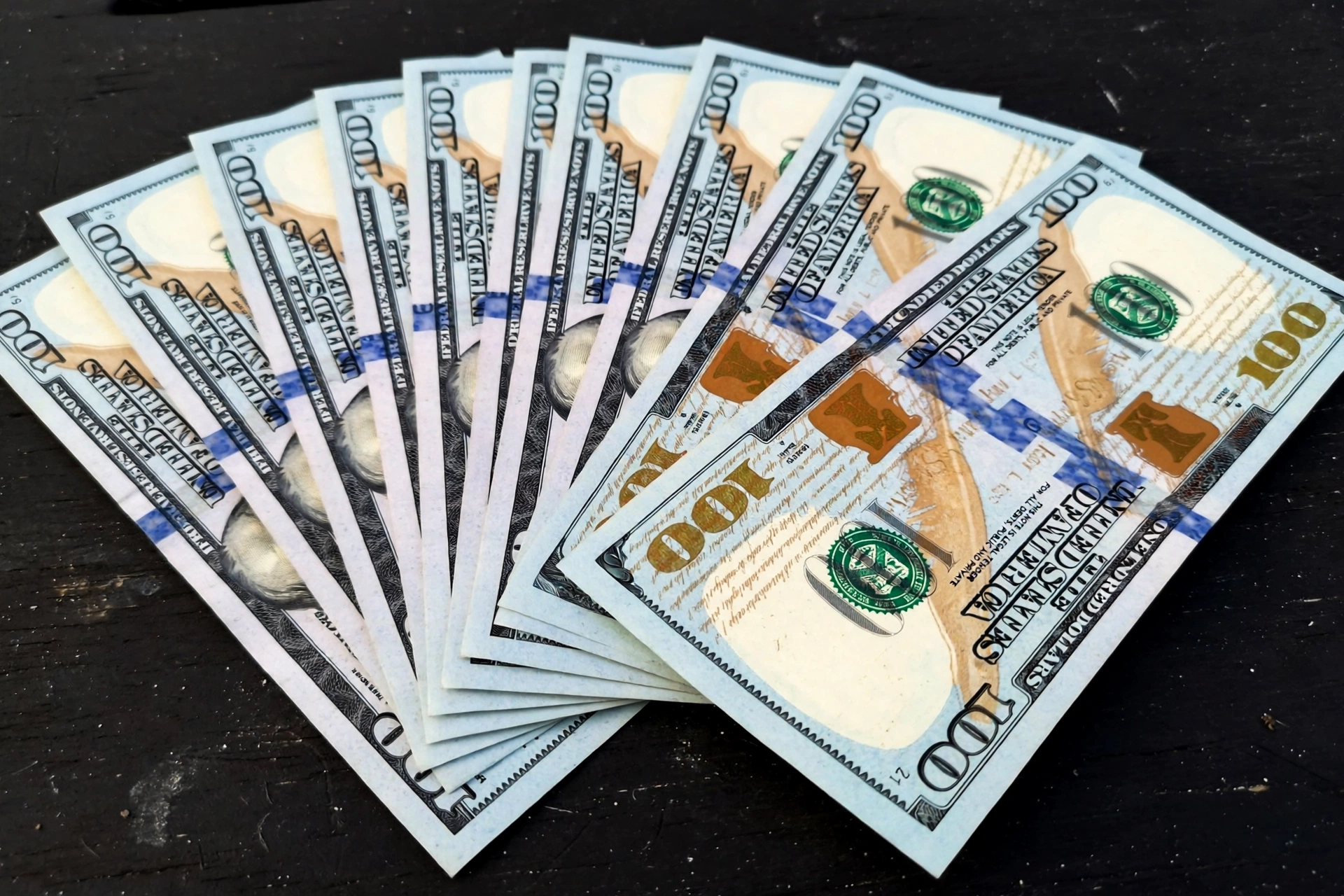




Quick Answer: The person on the 100 dollar bill is Benjamin Franklin, the American Founding Father, inventor, diplomat and printer. His portrait has appeared on the $100 bill since 1914, and the back of the note shows Independence Hall in Philadelphia. Franklin is one of only two people on current US paper money who was never president — the other is Alexander Hamilton on the $10 bill.
Quick Facts: Face on the $100 bill: Benjamin Franklin (1706–1790). First appeared on the $100: 1914, on the first Federal Reserve Notes. Born: 17 January 1706, Boston, Massachusetts; died 17 April 1790, Philadelphia. Back of the bill: Independence Hall, Philadelphia (since 1928). Nickname: $100 bills are called “Benjamins”. Largest denomination in circulation: since 1969, when $500, $1,000, $5,000 and $10,000 notes were retired. Latest major redesign: Series 2009, issued to the public on 8 October 2013. Average life of a $100 bill in circulation: about 24 years (as of May 2025).
Who Was Benjamin Franklin?
Benjamin Franklin was born in Boston on 17 January 1706, the 15th child of a candle-maker, and his formal schooling ended when he was ten years old. He became a printer, then a writer, scientist, inventor, diplomat and statesman — one of the most remarkable self-taught lives in American history. As a scientist he studied electricity, invented the lightning rod and the Franklin stove, and coined terms such as “battery” and “positive” and “negative” charge. As a diplomat he secured the alliance with France that made American independence possible, and he helped negotiate the Treaty of Paris in 1783 that ended the Revolutionary War. He was a signer of the Declaration of Independence and, at 81, the oldest delegate to the Constitutional Convention of 1787. He also served as the first Postmaster General of the United States and as the sixth President of Pennsylvania.
How Did Franklin End Up on the $100 Bill?
The first $100 notes, issued during the Civil War in the 1860s, did not feature Franklin. Early versions carried portraits of General Winfield Scott, Abraham Lincoln, Thomas Hart Benton, James Monroe and Admiral David Farragut, among others. Franklin’s portrait first appeared on the $100 in 1914, when the first Federal Reserve Notes were issued, and it has been there ever since. His portrait was based on a painting by the French artist Joseph Duplessis. He was chosen because he was one of the most prominent figures of the American Revolution and one of the best-known Americans in the world — a printer, inventor and diplomat whose face was already familiar in Europe as well as America. Fittingly, Franklin had been one of the most prominent printers in British America, and the colonies had asked him to print their paper money.
What Is on the Back of the $100 Bill?
The reverse of the $100 bill shows Independence Hall in Philadelphia, Pennsylvania, where the Declaration of Independence was signed in 1776 and the Constitution was written in 1787. Independence Hall has been on the back of the bill since 1928, when US currency was standardised to its current small size. The $100 is the only denomination in circulation today that features a building outside Washington, D.C. on its reverse. The front of the current note also contains stylised images of the Declaration of Independence, a quill pen, the Syng inkwell used to sign the Declaration, and the Liberty Bell.
The Modern $100 Bill and Its Security Features
The $100 bill was redesigned in the Series 2009 issue, unveiled on 21 April 2010 and issued to the public on 8 October 2013 after printing problems delayed it. The current design has a teal background, a larger portrait of Franklin with no border, and small yellow “100”s printed across the note. Its most famous security feature is the 3D security ribbon: a blue ribbon woven into the paper that shows images of bells and the number 100 moving when the note is tilted. Other features include a watermark of Franklin visible when the note is held to the light, colour-shifting ink on the bell in the inkwell, a security thread that glows pink under ultraviolet light, and microprinting. These features exist because the $100 is the most counterfeited US denomination worldwide — and also the most widely held: more than two-thirds of all $100 notes are held outside the United States, and the note makes up about 80 per cent of all US currency in circulation by value.
Why the $100 Matters
The $100 bill is the largest denomination the United States still prints. Larger notes — $500, $1,000, $5,000 and $10,000 — were retired on 13 July 1969 and are no longer printed, although a few remain in collectors’ hands. That makes the $100 the top of the range, and its nickname, “Benjamins”, is known around the world. Franklin’s face on the note is also a small piece of irony: the man who helped create the United States and printed its early paper money now appears on the country’s most important banknote, more than two centuries after his death, in a portrait reproduced billions of times. As one historian put it, every piece of American paper money is a billfold-size essay in American history — and the $100, with Franklin on the front and Independence Hall on the back, is the most widely read essay of them all.
FAQs
Q: Who is on the 100 dollar bill right now?
A: Benjamin Franklin, the Founding Father, inventor and diplomat.
Q: When did Franklin first appear on the $100 bill?
A: In 1914, on the first $100 Federal Reserve Notes. He has been on every $100 Federal Reserve Note since.
Q: Was Benjamin Franklin a president?
A: No. He was never president of the United States, although he was President of Pennsylvania. He is one of only two non-presidents on current US paper money, along with Alexander Hamilton on the $10 bill.
Q: What is on the back of the $100 bill?
A: Independence Hall in Philadelphia, where the Declaration of Independence was signed and the Constitution was written.
Q: Who was on the $100 bill before Franklin?
A: Several people appeared on 19th-century $100 notes, including Abraham Lincoln, General Winfield Scott, Thomas Hart Benton and James Monroe.
Q: Why are $100 bills called Benjamins?
A: After Benjamin Franklin, whose portrait is on the front. The nickname is used in the United States and around the world.
Q: What is the 3D security ribbon on the $100?
A: A blue ribbon woven into the paper of the modern $100 bill. When you tilt the note, images of bells and the number 100 appear to move along the ribbon. It is one of the hardest features to counterfeit.
Related reading: Who Is on the 20 Dollar Bill? and Who Is on the 50 Dollar Bill?
Sources: United States one-hundred-dollar bill — Wikipedia, Benjamin Franklin — Wikipedia and Who Is on the 100 Dollar Bill? — APMEX