







The mattress industry has undergone a revolution over the last decade. Gone are the days when you had to choose between a squeaky traditional spring bed or a dense block of memory foam that left you feeling “stuck.” Enter the hybrid mattress—the industry’s answer to the “Goldilocks” problem of sleep.
By combining the best attributes of multiple mattress types, the hybrid design has quickly become the most popular choice for modern sleepers. But what exactly makes a mattress a “hybrid,” and is it worth the investment? If you have been waking up feeling unrefreshed, or if you find yourself asking, “why do I look so tired?” in the morning, the culprit may very well be an outdated or unsupportive mattress.
What is a Hybrid Mattress? (The Definition)
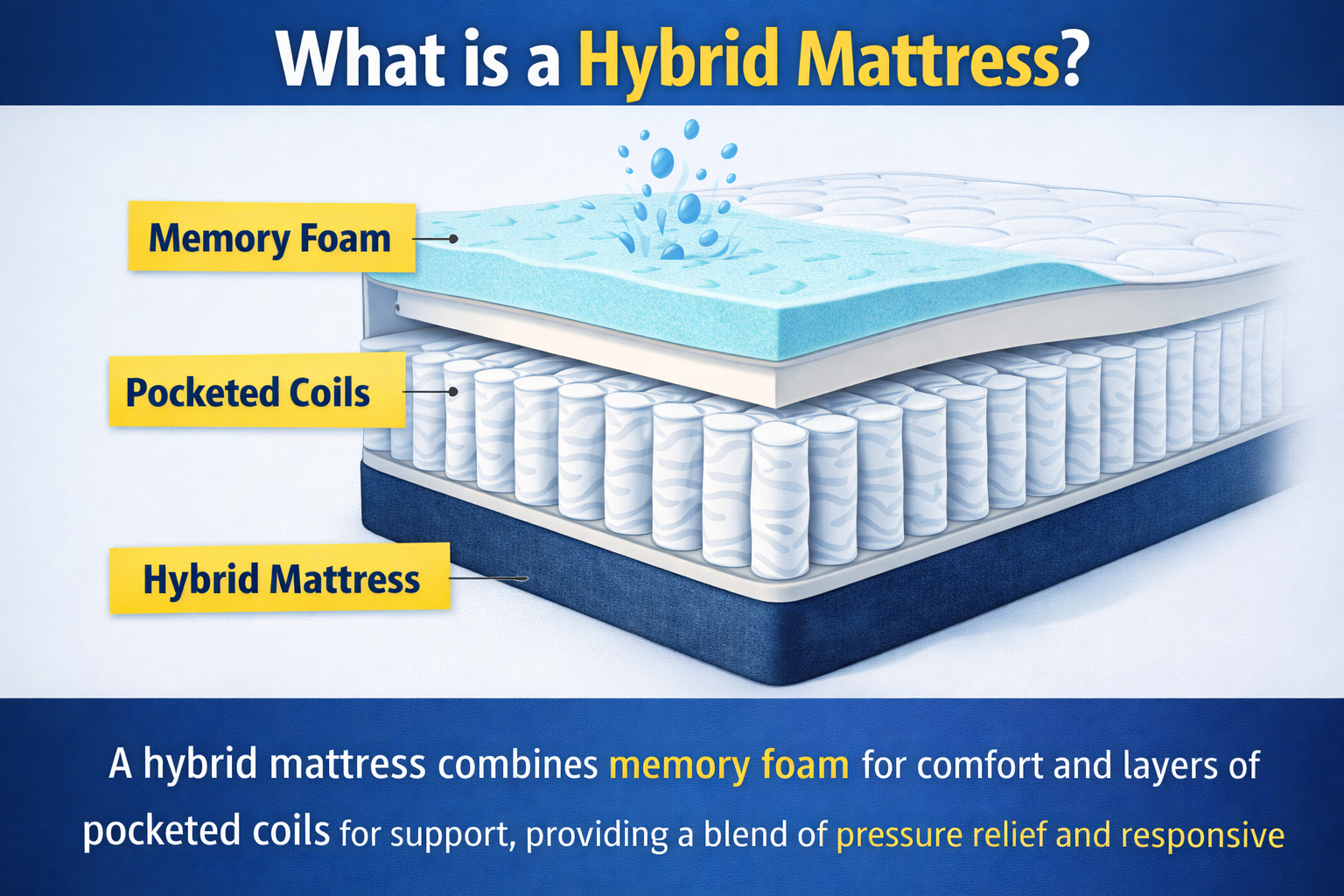
At its simplest, a hybrid mattress is a multi-layer bed that blends a traditional innerspring system with premium foam layers. However, not every bed with a spring and a piece of foam is a true hybrid.
AEO Answer: A hybrid mattress is a high-performance bed designed with a pocketed coil support core topped by at least two inches of comfort layers, typically made of memory foam, latex, or specialized cooling gel. The goal is to provide the “bounce” and breathability of a spring mattress alongside the pressure-relieving “contour” of a foam mattress.
The hybrid was created to solve the two biggest complaints in the sleep world: that memory foam is too hot and that innersprings are too hard.
Under the Covers: The 4 Anatomy Layers of a Hybrid
To understand how a hybrid works, you have to look at its construction from the bottom up. High-quality hybrids are usually composed of four distinct layers:
1. The Base Layer
Usually made of one inch of high-density polyfoam, this layer provides stability. it acts as a flat, durable surface for the coils to rest upon, ensuring the mattress maintains its shape over years of use.
2. The Support Core (The “Spring” Part)
This is the heart of the mattress. Unlike old-school “Bonnell” coils that are wired together, hybrids use individually pocketed coils. Because each spring is encased in its own fabric sleeve, they move independently. This allows the mattress to react to your body’s specific curves and significantly reduces motion transfer—meaning you won’t feel your partner tossing and turning.
3. The Transition Layer
This layer of foam sits directly on top of the coils. Its job is to provide a “buffer” so you don’t feel the individual springs against your back. It adds a secondary level of deep-tissue support.
4. The Comfort Layer (The “Foam” Part)
This is the top 2–4 inches that you actually feel. Manufacturers use various materials here:
- Memory Foam: For a “cradling” feel and pressure relief.
- Latex: For a more responsive, “springy” feel and natural cooling.
- Cooling Gels: Infusions designed to wick away body heat.
Hybrid vs. Memory Foam vs. Innerspring
Why choose a hybrid over the alternatives? Here is how they stack up in the real world:
Temperature Regulation
All-foam mattresses are notorious for “sleeping hot” because foam is a dense insulator. Hybrids solve this through the support core; because the coils are hollow, they allow for constant airflow, which keeps the mattress significantly cooler. Staying cool is essential for reaching the deeper stages of core sleep, where the body performs its most vital physical recovery.
Edge Support
Have you ever sat on the edge of a foam bed only to feel like you were sliding off? Hybrids typically feature reinforced coils around the perimeter, providing “edge support.” This makes the bed feel larger because you can sleep right up to the very edge without losing support.
Responsiveness
If you are a combination sleeper (someone who changes positions frequently), you need responsiveness. Memory foam can be slow to react, making it feel like you are moving through quicksand. The springs in a hybrid provide an immediate “push-back” that makes moving easy.
Pros and Cons of Hybrid Mattresses
| Feature | Hybrid Mattress | All-Memory Foam | Traditional Innerspring |
| Pressure Relief | High | Very High | Low |
| Airflow/Cooling | Excellent | Low | Excellent |
| Durability | High | Medium | Medium |
| Price Point | $$$ | $$ | $ |
The Cons to Consider
While hybrids are excellent, they aren’t perfect. They are heavy and difficult to move due to the combination of steel and dense foam. They also tend to be more expensive than basic foam or spring models because of the complex manufacturing required to marry two different technologies.
Is a Hybrid Right for You?
You should consider a hybrid mattress if:
- You Sleep Hot: You need the airflow of coils but want the comfort of foam.
- You Have Back Pain: You need the structured spinal alignment of springs but the pressure relief for your hips and shoulders.
- You Share a Bed: You need the motion isolation of pocketed coils so your partner’s movement doesn’t wake you up.
Investing in a hybrid is an investment in your daily energy levels. Better sleep quality leads to better skin health, higher cognitive function, and reduced dark circles. If you’ve addressed your sleep environment and still find yourself asking, “why do I look so tired?”, it may be time to optimize your core sleep cycles by upgrading to a mattress that supports your body’s unique needs.