






Building a new home? Replacing an old, creaky door? Or maybe you just bought a lifted truck and are worried it won’t clear the header.
The garage door is the largest moving part of your home.1 Getting the size wrong isn’t just an aesthetic issue—it is a functional disaster.2 A door that is too narrow leads to scraped side mirrors. A door that is too low means you can’t park your SUV inside.
While there are “standard” sizes in the industry, the reality of construction is that sizes vary wildly depending on the age of your home and the type of vehicles you own. This guide breaks down every dimension you need to know, from single bays to massive RV garages.
Quick Reference: Standard Garage Door Sizes Chart
If you are in a rush, here are the most common industry-standard sizes used by major manufacturers like Clopay, Amarr, and Wayne Dalton.
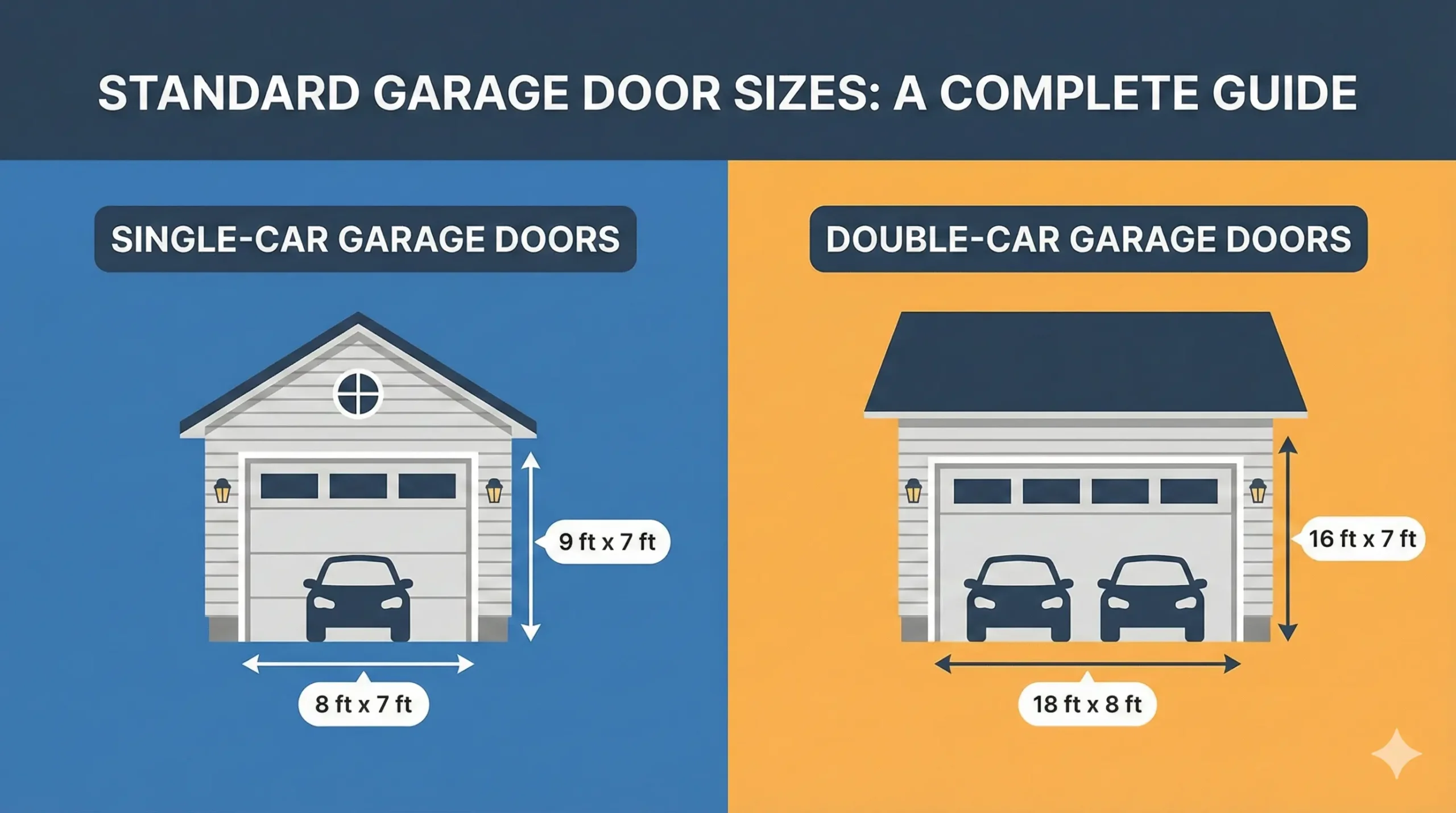
| Door Type | Standard Widths | Standard Heights | Best For |
| Single Car | 8 ft, 9 ft, 10 ft | 7 ft, 8 ft | Sedans, Small SUVs, Motorcycles |
| Double Car | 16 ft, 18 ft | 7 ft, 8 ft | Two standard vehicles, Large SUVs |
| Golf Cart | 5 ft, 6 ft | 7 ft | Golf carts, Riding mowers, Sheds |
| RV / Oversized | 10 ft, 12 ft, 14 ft | 10 ft, 12 ft, 14 ft | Class A Motorhomes, Boats, Trailers |
Note: Dimensions are always listed as Width x Height. A “9×7” door is 9 feet wide and 7 feet tall.3
Part 1: Single Car Garage Door Sizes
In older homes (pre-1990s), single doors were compact. In modern construction, they are getting wider to accommodate today’s larger vehicles.
The 8 x 7 Foot Door (The Old Standard)
This is the most common size found in tract homes built in the 70s, 80s, and 90s.
- Will my car fit? Yes, a standard sedan (Honda Civic, Toyota Camry) fits fine.4
- The Problem: Large pickup trucks (Ford F-150, Ram 1500) are roughly 80 inches wide without mirrors. With mirrors, they can be over 96 inches (8 feet). You will likely have to fold your mirrors in every time you park.
The 9 x 7 Foot Door (The New Standard)
If you are building a new house, do not install an 8-foot door. Go with 9 feet.
- The Benefit: That extra 12 inches of width makes a massive difference. You can pull a full-size SUV or truck in without folding mirrors. It also makes entering the garage at an angle much easier.
The 10 x 7 Foot Door (The Luxury Single)
Though less common, 10-foot wide single doors are gaining popularity in custom homes. They provide ample room for wide sports cars or for storing storage racks along the side walls while still parking a car.
Part 2: Double (2-Car) Garage Door Sizes
A double door eliminates the center post between bays, making it easier to maneuver two cars.
The 16 x 7 Foot Door (The Standard Double)
This is the default size for 90% of two-car garages in America.
- Capacity: It fits two mid-sized cars (like two Toyota RAV4s) comfortably.
- The Squeeze: If you try to park two full-size trucks side-by-side, it will be tight. You may not be able to open the doors of the vehicles fully without hitting the other car.
The 18 x 7 (or 18 x 8) Foot Door (The Upgrade)
If you have the space, an 18-foot door provides luxury spacing.
- The Benefit: This allows two large vehicles to park with plenty of space between them to open doors, load groceries, or get kids out of car seats without dinging the adjacent car.
Part 3: The Critical Factor—Height (7ft vs. 8ft)
Most people focus on width, but height is where many homeowners make a mistake.
- 7-Foot High (Standard): This clears almost all sedans and standard crossovers.
- 8-Foot High (Recommended): If you drive a lifted Jeep, a truck with a roof rack, or have a cargo box (Thule/Yakima) on top of your SUV, a 7-foot door will likely clip the top.5
- Pro Tip: If you are building, frame for an 8-foot height. You can always put a smaller door in a larger hole (with framing modifications), but you can’t easily make the hole bigger later.
Part 4: RV and Commercial Sizes
Recreational Vehicles (RVs) and boats require specialized doors. Standard residential tracks won’t cut it; these often require commercial-grade hardware.
- Height:
- 10 feet: Fits small travel trailers and some boats.
- 12 feet: Fits most Class B and Class C motorhomes.
- 14 feet: Required for large Class A motorhomes with AC units on the roof.
- Width: While 10 feet wide is possible, 12 feet wide is recommended for RVs to allow for error when backing in a massive rig.
Part 5: How to Measure for a Replacement Door
If you are buying a door, you don’t just measure the old door. You measure the opening. Here is the 4-step checklist.
1. Measure the Width and Height (The Rough Opening)
Measure the distance between the left and right side of the finished opening (the wood jambs).
- Rule: The rough opening should be the exact same size as the door you are buying.
- Example: For a 9×7 door, the opening should be exactly 9 feet wide and 7 feet tall. The door sits behind the opening and seals against the jambs.
2. Measure the Sideroom
This is the distance from the edge of the door opening to the nearest wall or obstruction.
- Requirement: You need at least 3.75 to 4.5 inches on each side for the vertical tracks and cables.
- Spring System: If you are using torsion springs (the bar above the door), you need more sideroom (usually 5+ inches) to access the cables.
3. Measure the Headroom
This is the distance from the top of the door opening to the ceiling (or the lowest obstruction like a light fixture or duct).
- Standard Track: Needs 12 to 15 inches of headroom.6
- Low Headroom Track: Can work with as little as 4.5 to 9 inches, but it costs more and operates less smoothly.
- Opener Space: Don’t forget to add 2-3 inches for the garage door opener rail.
4. Measure the Backroom
This is the distance from the garage door opening back into the garage.
- Rule: Door Height + 18 inches.
- Example: For a 7-foot tall door, you need at least 8.5 feet of unobstructed depth for the door to slide up and back.
Part 6: Does My Car Fit? (Vehicle Size Guide)
Before you finalize your garage plan, check your specific vehicle dimensions.
| Vehicle Type | Average Width (w/ mirrors) | Average Height | Recommended Door |
| Sedan (Civic) | 6 ft | 4.8 ft | 8 x 7 ft |
| Mid-Size SUV (Explorer) | 7.5 ft | 5.8 ft | 9 x 7 ft |
| Full-Size Truck (F-150) | 8.1 ft | 6.5 ft | 9 x 7 ft (min), 9 x 8 ft (better) |
| Lifted Truck | 8.5 ft+ | 7 ft – 7.5 ft | Must have 8 ft height |
| Sprinter Van | 8 ft | 9 ft+ | 10 ft height |
Part 7: Custom Sizes and Costs
What if your opening is 8’3″?
Most manufacturers offer custom sizes in 1-inch increments.
- Cost: Custom sizing usually adds 40-50% to the cost of the door compared to a stock size.
- Alternative: If your opening is non-standard (e.g., 98 inches wide instead of 96), it is often cheaper to frame in the opening. Adding 2 inches of wood to the door jambs to make it a standard size is significantly cheaper than ordering a custom door.
Conclusion: Measure Twice, Order Once
Selecting the right garage door size comes down to future-proofing.
- Go Wider: If you have the space, choose 9ft over 8ft, and 18ft over 16ft.
- Go Higher: The minimal cost difference to upgrade from 7ft to 8ft height adds massive resale value for future truck/SUV owners.
- Check Headroom: The number one reason installations fail is a lack of clearance between the door and the ceiling.
When in doubt, consult a professional installer to perform a “site check.” A $50 service call now can save you a $2,000 restocking fee on a door that doesn’t fit.