







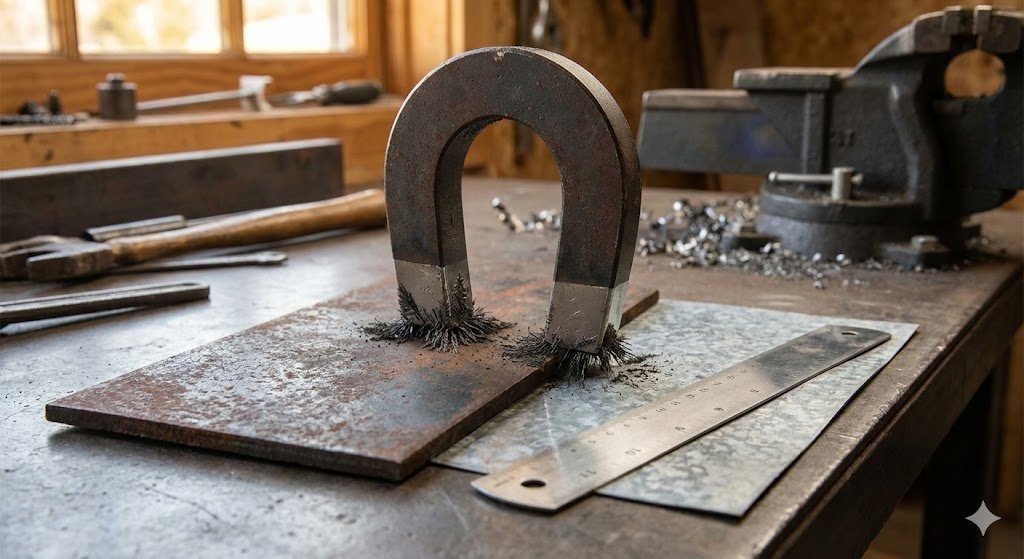
You grab a magnet to stick a note to your refrigerator, and it snaps on tight. But when you try to stick that same magnet to your stainless steel kitchen sink, it likely slides right off. Both are made of “steel,” so why does one attract a magnet while the other ignores it?
If you are searching for “is steel magnetic”, the answer isn’t a simple yes or no. While steel is an alloy made primarily of iron (the most magnetic element), the addition of other metals can cancel out its magnetic properties completely.
This guide explains which types of steel will stick to a magnet, why high-quality stainless steel often doesn’t, and how to tell the difference between the metal grades in your home.
Is Steel Magnetic? (Carbon & Galvanized)
For the vast majority of steel used in construction and automobiles, the answer is yes.
Carbon Steel Standard steel (often called carbon steel) is ferromagnetic. This means it is strongly attracted to magnets. Whether it is a steel beam, a nail, or the body of your car, it is made almost entirely of iron, which aligns perfectly with magnetic fields.+1
Is Galvanized Steel Magnetic? A common question is, “is galvanized steel magnetic?”.
- The Verdict: Yes.
- The Reason: Galvanization is simply a process of coating standard carbon steel with a thin layer of zinc to prevent rust. While zinc itself is non-magnetic, the layer is so thin that a magnet easily “sees through” it to grip the steel core underneath.
Maintenance Tip: Because these magnetic steels are iron-based, they are prone to corrosion if their protective coating is scratched. If you are dealing with plated metals that have started to spot or corrode, you might need to learn how to get rust off chrome or galvanized surfaces to stop the damage from spreading.
Is Stainless Steel Magnetic? (The Confusion)
This is where things get complicated. If you ask, “is stainless steel magnetic”, the answer depends entirely on the “grade” of the steel.
Stainless steel is classified into families based on its crystal structure:
- Ferritic Stainless Steel (Magnetic): These grades (like the 400-series) have a high concentration of iron and chromium. Magnets will stick to them. You often find this type of steel in refrigerator doors, budget-friendly cutlery, and automotive exhaust tips.
- Austenitic Stainless Steel (Non-Magnetic): These grades (like the 300-series) contain nickel. The nickel changes the crystal structure of the steel (turning it into “austenite”), which effectively cancels out the magnetic properties of the iron. This is the steel used for kitchen sinks, high-end pots, and medical tools.
304 vs. 316: The Specific Grades
When buying hardware or jewelry, you will often see numbers like 304 or 316. These are the two most common types of austenitic stainless steel.
Is 304 Stainless Steel Magnetic?
- Generally, No. Grade 304 (also known as 18/8 stainless) is the most common stainless steel in the world. In its raw form, it is non-magnetic.
- The Exception: If 304 steel is bent, drawn into a wire, or cold-worked heavily, its structure can partially change, making it slightly magnetic. This is why a magnet might stick weakly to the bent corner of a stainless steel sink but fall off the flat bottom.
Is 316 Stainless Steel Magnetic?
- No. Grade 316 is “marine grade” or “surgical grade” steel. It contains molybdenum to resist salt corrosion. This addition reinforces the austenitic structure, making it virtually non-magnetic in almost all conditions.
Jewelry Application: Because it is non-magnetic and highly resistant to body oils, 316L steel is the gold standard for body piercing and jewelry. This durability makes it a top choice for modern trends like what is permanent jewelry, where a bracelet is welded onto your wrist and must withstand daily wear without reacting to magnetic fields or rusting.
Why Does This Matter? (Cooking & Recycling)
Knowing whether your steel is magnetic is more than just a science trick—it has practical uses.
- Induction Cooking: Induction cooktops work by using magnetic fields to heat the pot directly. For a pan to work on an induction stove, it must be magnetic. If a magnet sticks to the bottom of your pot, it is induction-ready. If not (like many aluminum or 304 stainless pots), it won’t heat up.
- Scrap Metal Recycling: Scrap yards pay different prices for “Ferrous” (magnetic) and “Non-Ferrous” (non-magnetic) metals. Non-magnetic stainless steel (like 304/316) is generally worth more per pound than magnetic steel scrap.
Conclusion
So, is steel magnetic?
- If it is a rusty nail or a galvanized fence post: Yes.
- If it is a cheap knife: Yes.
- If it is a high-quality kitchen sink or surgical tool: No.
The next time you are unsure about a piece of metal, perform the “fridge magnet test.” It is the quickest way to reveal the invisible chemistry inside the alloy.