





Wiring a standard UK 3-pin plug is a fundamental DIY skill, but it requires strict attention to detail. Electricity does not leave room for guesswork. Whether you are replacing a cracked plug or shortening a long cable, the process is straightforward if you follow the exact standards.
The Golden Rule: Safety always comes first. Ensure the appliance is completely disconnected from the mains power before you even touch a screwdriver to the cable.
Preparation & Safety First
Before you make any connections, you need to prepare the cable correctly.
- Use a screwdriver to loosen the central screw and remove the plug cover.
- Loosen the cord grip (the small clamp at the bottom of the plug).
- Carefully strip about 4 cm of the thick outer cable sheath. Warning: You must score the outer layer gently to pull it away without nicking or cutting the coloured insulation of the inner wires.
- Cut the inner wires to the correct length so they comfortably reach their designated terminals. The Earth wire (green and yellow) should be left slightly longer than the others. This ensures that if the cable is ever pulled forcefully, the Earth wire is the absolute last one to disconnect, keeping the appliance grounded for as long as possible.
The UK Plug Wire Colour Code
Getting the colours right is non-negotiable. Modern UK cables follow a strict colour code:
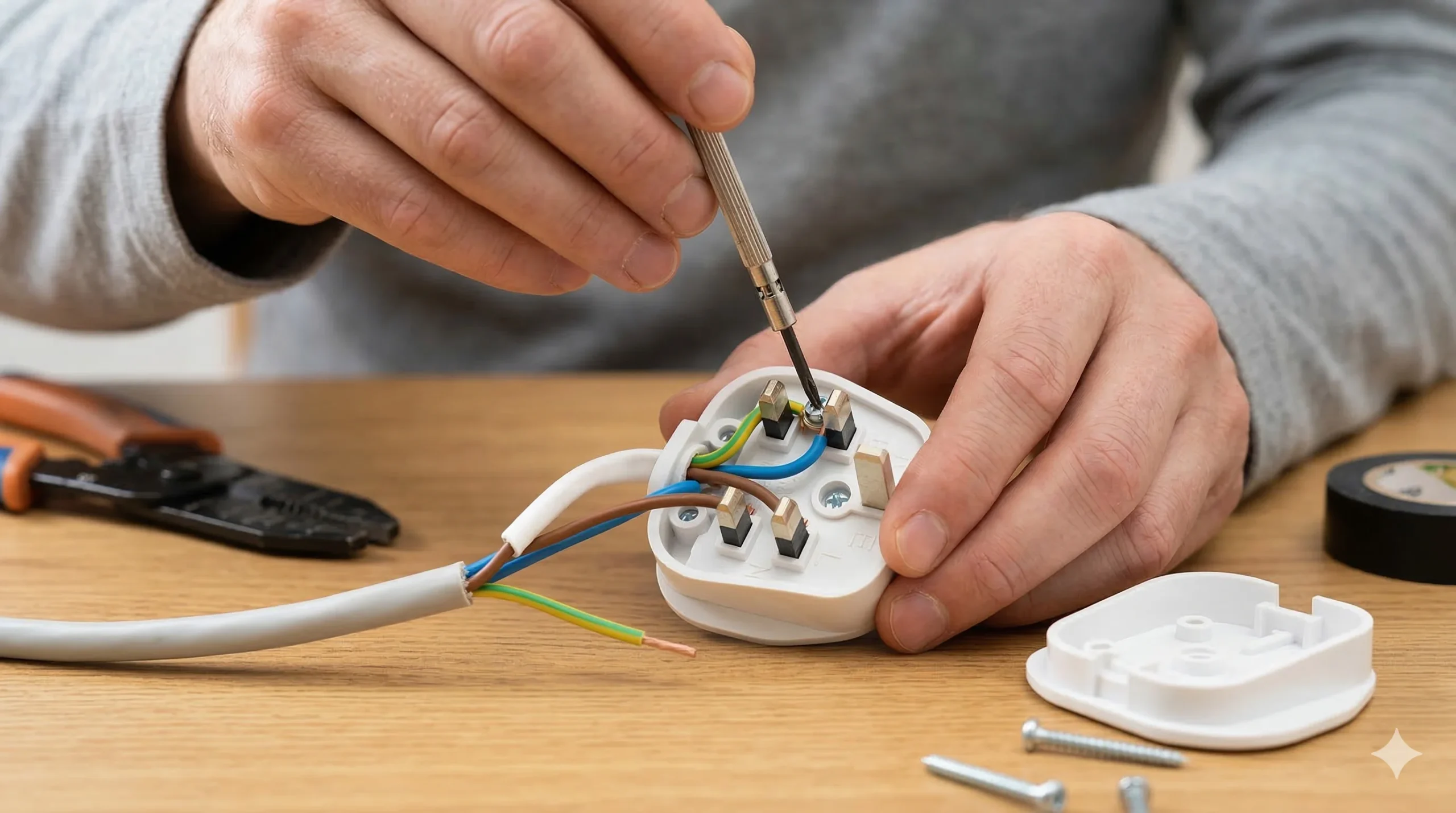
- Brown (Live): Connects to the ‘L’ terminal on the right side, directly next to the fuse.
- Blue (Neutral): Connects to the ‘N’ terminal on the left side.
- Green and Yellow striped (Earth): Connects to the top ‘E’ terminal (the longest pin).
Important Note: Some modern appliances are “double-insulated.” If you open the cable and only see a Brown and Blue wire, do not panic. These devices do not require an Earth wire.
Step-by-Step Wiring Instructions
1. Strip and Twist the Wires
Strip exactly 5 mm of the coloured plastic insulation from the end of each inner wire to expose the copper. Twist the exposed copper strands tightly in a clockwise direction. This prevents the delicate strands from fraying and ensures a solid, clean connection inside the terminal.
2. Connect the Wires to the Terminals
Thread each twisted copper wire into its respective metal terminal hole and tighten the small screw down onto it.
The crucial check: A loose connection or stray copper wire inside the plug is a common reason why circuit breakers keep tripping, so ensure the terminal screws are clamped down tightly directly onto the copper, not the plastic insulation. Furthermore, no bare copper should be visible outside the metal terminals. If you can see bare copper, unscrew the terminal, trim the wire slightly, and try again to prevent short circuits.
3. Secure the Cord Grip
The cord grip clamp at the base of the plug is there to take the physical strain off the electrical connections. It must clamp down tightly over the thick outer cable sheath. It should never clamp down on the individual coloured inner wires.
Choosing the Right Fuse: 3A vs. 13A
The fuse is a deliberate weak point designed to protect the cable from overheating and catching fire if there is a fault. You must use the correct rating:
- 3A (Red) Fuse: Use this for low-power appliances under 700W. This includes table lamps, radios, televisions, and phone chargers.
- 13A (Brown) Fuse: Use this for high-power devices over 700W. High-wattage appliances that generate heat, like a toaster or a kitchen kettle—especially if you are doing routine maintenance like learning how to descale a kettle—will always require a 13A fuse.
Final Reassembly and Checks
Before closing the plug, do one final visual inspection:
- Are the colours in the correct terminals (Brown right, Blue left, Green/Yellow top)?
- Is there any bare copper showing?
- Is the cord grip clamped firmly over the thick outer sheath?
- Is the correct fuse seated properly in its clips?
If everything looks clean and secure, push the plug cover back on and tighten the central screw securely.
FAQs on Wiring a UK Plug
Why does my cable only have two wires? This means the appliance is double-insulated and does not need an Earth connection to be safe. Simply connect the Brown (Live) and Blue (Neutral) wires to their correct terminals and ignore the top Earth pin.
Can I use a 13A fuse in a lamp plug just to be safe? No, this is highly dangerous. Using a 13A fuse on a thin cable meant for a low-power appliance creates a fire hazard. If a power surge occurs, the thin cable could overheat and melt completely before the 13A fuse ever blows. Always match the fuse to the appliance’s power draw.
Taking an extra 60 seconds to double-check your wire colours, ensure a tight cord grip, and verify your fuse rating guarantees your appliance is safe to use.