





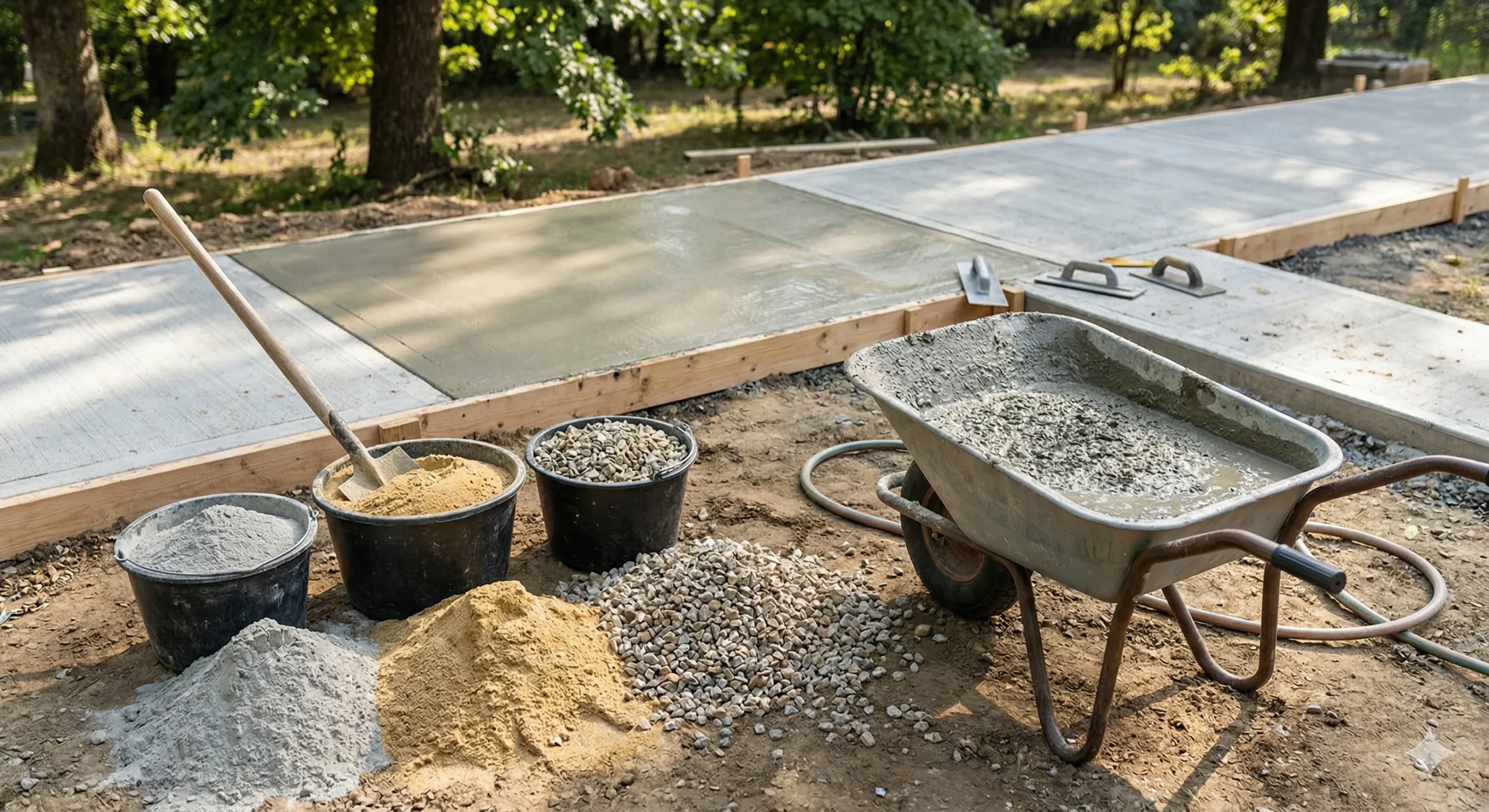

Before you pick up a shovel, it is vital to clear up the most common misconception in DIY construction: cement is not concrete. Cement is merely the binder—the fine grey powder that acts as the glue. Concrete is a precise chemical recipe composed of that cement, sharp sand, and heavy aggregate (gravel or crushed stone).
If you get this ratio wrong, you are not just making a messy mix; you are guaranteeing a crumbling, weak slab that will crack under pressure and weather away within a year. Making concrete is a science, not a guessing game. Here is your definitive builder’s guide to understanding mix ratios, the exact physical process of mixing, and the strict timelines required for a slab to reach its maximum structural strength.
Standard UK Concrete Mix Ratios (The Math)
The structural strength of concrete is categorized into grades (such as M10 or M20), which denote the compressive strength of the cured slab in megapascals. Regardless of the grade, the standard mixing format is always universally read as Cement : Sand : Aggregate.
To achieve these specific grades, you must measure your parts accurately by volume (using the same bucket or shovel for every scoop). Here are the three core recipes every builder relies on:
- 1:3:6 (M10 Grade): This is a relatively weak, economical mix consisting of one part cement, three parts sand, and six parts aggregate. It is the standard mix for non-load-bearing projects like garden paths, setting fence posts, or general domestic patching.
- 1:2:4 (M15 Grade): This is the standard structural mix used for domestic floors, shed bases, and light foundations. It offers a much higher cement-to-stone ratio, providing excellent durability.
- 1:1.5:3 (M20 Grade): This is the heavy-duty mix required for driveways, garage floors, and any concrete pad supporting heavy vehicle loads. Whether you are pouring a simple garden path or calculating the foundation materials for how much does it cost to build a house in the UK, getting this specific ratio right is your absolute first priority to ensure structural integrity.
Step-by-Step: How to Mix Concrete Properly
Knowing the math is only half the job. The physical execution dictates whether the chemicals will bond correctly.
1. The Dry Mix
Measure your parts accurately into a heavy-duty wheelbarrow, a mechanical cement mixer, or onto a clean mixing board. The golden rule here is that all dry ingredients must be turned over and blended thoroughly until the pile achieves a completely uniform, grey color before a single drop of water touches the mix. If you have pockets of pure sand or pure cement, your final slab will have weak spots.
2. Adding the Water
Water is the catalyst that triggers the chemical reaction, but it is also the biggest risk factor. The most common mistake amateurs make is adding too much water to make the heavy concrete easier to shovel. Drowning your mix severely dilutes the cement paste, pushing the aggregate apart and resulting in a brittle, porous slab.
Form a crater in the center of your dry pile and add the water very slowly, turning the mix inward from the edges.
3. The Squeeze Test
You will know your concrete is perfectly mixed by relying on visual and physical cues. Pick up a handful of the wet mix (always wearing heavy rubber gloves, as wet cement causes severe chemical burns) and squeeze it into a ball.
- It should hold its shape firmly without slumping.
- It must not be dry or crumbly.
- It must absolutely not squeeze through your fingers like a watery soup. If the mix looks glossy and water bleeds to the surface immediately in the wheelbarrow, it is too wet, and you must add a small, proportionate amount of dry mix to recover it.
Concrete Drying Times vs. Curing Times
One of the most critical builder-level concepts to understand is that concrete does not “dry” by water evaporation. If the water evaporates, the slab dies. Concrete “cures” through an exothermic chemical reaction called hydration, where the cement paste crystallizes and binds to the stone.
Because this is a chemical reaction, it happens on a strict, unchangeable timeline:
- 24 to 48 Hours: The concrete is hard enough to safely withstand foot traffic. You can carefully remove wooden formwork at this stage.
- 7 Days: The slab reaches approximately 70% of its final structural strength. At this point, the chemical bonds are strong enough that it is safe to drive standard vehicles onto a driveway.
- 28 Days: The hydration process is considered clinically complete. The concrete has reached 100% of its maximum compressive strength.
Note: If you are using specialized, quick-setting post-hole mixes (often sold in bags that you pour dry into a water-filled hole), these contain heavy chemical accelerators. They flash-cure and are ready to support a fence post or foot traffic in as little as 2 hours.
How to Protect Curing Concrete
Because hydration relies on the presence of moisture, how you treat the concrete after you pour it is just as important as how you mixed it.
- Keep it Moist: If the sun or wind pulls the water out of the top layer of your wet slab too quickly, the hydration process instantly stops. The surface will shrink rapidly and develop hundreds of hairline cracks (called crazing). To prevent this, cover the wet slab with thick plastic sheeting to trap the moisture, or gently mist the surface with a garden hose twice a day during hot weather.
- Temperature Warnings: Extreme weather is the enemy of fresh concrete. High heat causes rapid evaporation and shrinkage cracks. Frost, however, is lethal. If the temperature drops below freezing and the water inside the wet concrete freezes before the hydration process finishes, the microscopic ice crystals will expand and physically shatter the internal structure of the slab, turning it to dust.
FAQs on Mixing Concrete
Can I mix concrete directly on the ground? You can mix small batches manually on a clean, flat piece of plywood or a heavy-duty plastic tarp. However, mixing directly on bare soil is a terrible idea; the dirt will contaminate the mix, and the dry ground will instantly suck the water out of your concrete before you can even shovel it. Using a wheelbarrow or renting a mechanical cement mixer is vastly superior for controlling water runoff and saving your back.
Do I need steel mesh inside my concrete? This depends entirely on the load. For a standard 4-inch thick garden path (M10 grade) that only sees foot traffic, no steel is required. However, for a driveway (M20 grade) that will be supporting heavy, moving vehicles, inserting steel rebar or a wire mesh grid into the center of the wet pour is highly recommended. Concrete has immense compressive strength (it can hold heavy weight pushing down) but poor tensile strength (it cracks when stretched or bent). The steel mesh prevents the slab from cracking under the tensile load of a rolling car tire.
Making durable concrete is entirely about discipline. Stick rigidly to your standard volume ratios, never drown the mix in water just to make the shoveling easier, and respect the 28-day curing timeline by protecting the slab from extreme weather. If you follow the math, the chemistry will do the rest, resulting in a slab that will easily last for decades.