



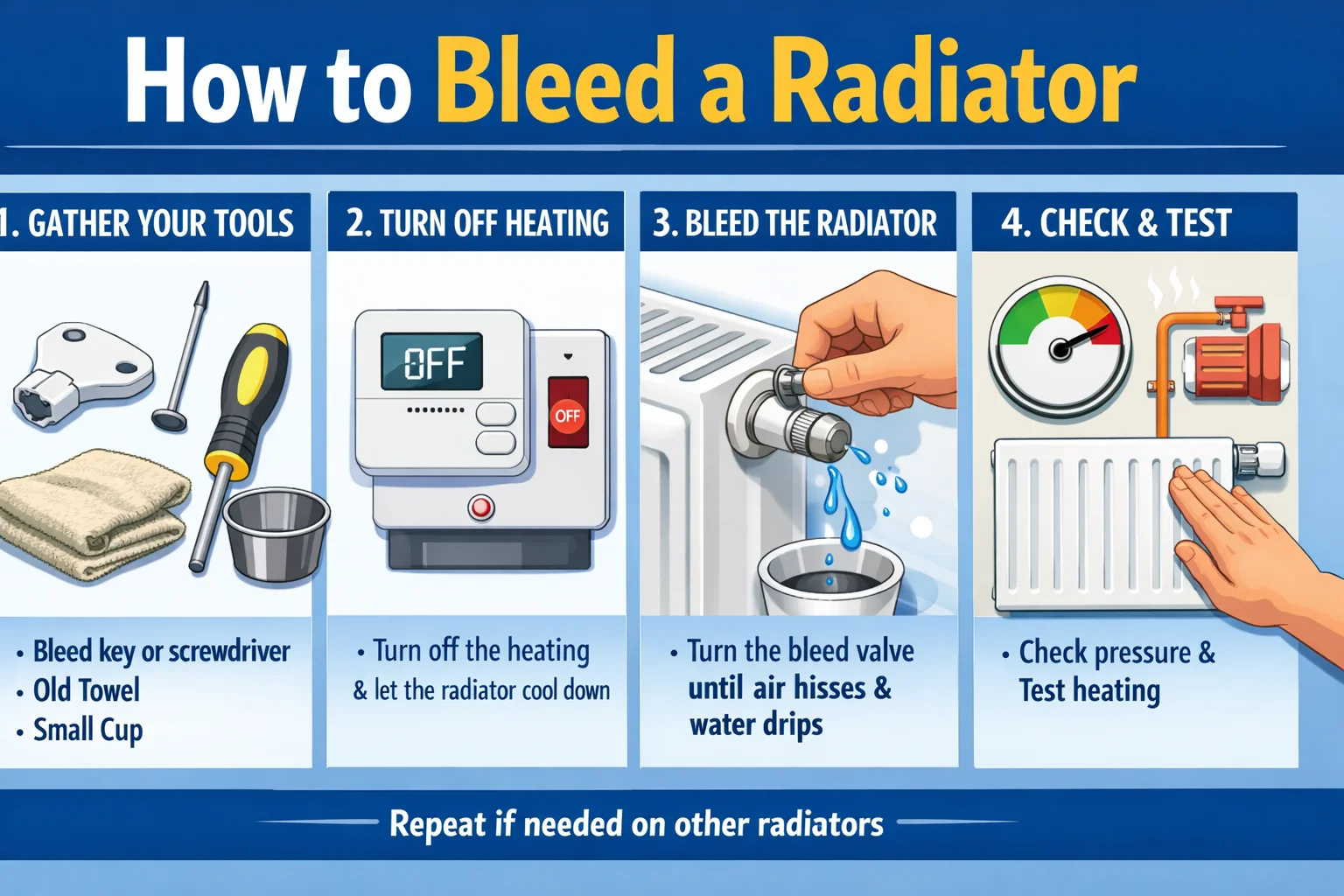
As the cold winter months settle in across the UK, there is nothing more frustrating than a central heating system that refuses to get up to temperature. If you have noticed that your rooms are staying chilly despite the heating being on full blast, the culprit is likely trapped air. Learning how to bleed a radiator is a vital home maintenance skill that can restore your home’s warmth and significantly lower your energy costs.
This comprehensive 2026 guide covers everything from the basic process to specialized tips for towel rails and how to handle the job if you have lost your radiator key.
Quick Summary: How Long to Bleed a Radiator?
If you are wondering how long to bleed a radiator, the process itself is remarkably quick. Typically, it takes about 20 to 30 seconds per radiator to release the trapped air until water begins to flow. However, you should factor in an additional 10 to 15 minutes for the system to cool down before you begin and a few minutes at the end to check your boiler pressure.
Why Do Radiators Need Bleeding?
Over time, air can enter your central heating system through small leaks, during pump repairs, or as a byproduct of corrosion within the pipes. This air rises to the highest points of your heating circuit—usually the top of your radiators.
Since air does not conduct heat as effectively as water, these air pockets create “cold spots.” If you find yourself wondering why is my electric bill so high, inefficient heating systems caused by trapped air in radiators are often a hidden culprit, as your boiler must work twice as hard to reach the desired thermostat temperature.
Step-by-Step Guide: How to Bleed a Radiator (UK)
1. Identify the Problem
Turn your heating on and wait for the radiators to warm up. Carefully feel the surface of each unit. If the bottom is hot but the top is cold, you have found an air pocket. You may also hear gurgling or “pipes banging” sounds.
2. Switch Off the Heating
This is the most important safety step. Turn off your central heating and wait for the radiators to be cold to the touch. Bleeding a hot radiator can result in scalding water spraying out under pressure.
3. Prepare Your Tools
To perform a standard how to bleed a radiator uk procedure, you will need:
- A radiator bleed key (available at most hardware stores).
- A dry cloth or rag.
- A small bowl or tray to catch drips.
4. Open the Valve
Locate the bleed valve, usually a small square metal peg inside a round nut at the top corner of the radiator. Insert the key and wrap your cloth around it. Slowly turn the key anti-clockwise (usually a quarter to a half turn). You will hear a hissing sound—this is the trapped air escaping.
5. Close and Tighten
Keep the valve open until the hissing stops and a steady stream of water starts to emerge. Quickly turn the key clockwise to seal the valve. Do not over-tighten, as you could snap the valve head.
How to Bleed a Radiator Without a Key
It is a common scenario: you go to fix your heating only to realize the radiator key has vanished. If you need to know how to bleed a radiator without a key, check the center of your bleed valve. Many modern UK radiators have a small slot in the center of the valve peg designed to fit a flat-head screwdriver.
If your valve is completely rounded or lacks this slot, do not attempt to use pliers, as this can “round off” the bolt and make it impossible to open in the future. In this case, it is best to purchase a universal key from a local DIY shop.
Special Cases: How to Bleed a Towel Radiator
Towel rails (or ladder radiators) are common in bathrooms and are notorious for trapping air due to their height. The process for how to bleed a towel radiator is largely the same, but the bleed valve is often hidden behind a decorative cap at the very top of one of the vertical pillars. Because these are often the highest point in the entire house, they may require more frequent bleeding than standard horizontal units.
Final Step: Check the Boiler Pressure
Bleeding radiators releases pressure from your system. Once you have finished all the radiators in your home, go to your boiler and check the pressure gauge.
- Normal Range: Usually between 1.0 and 1.5 bar (the green zone).
- Low Pressure: If the needle has dropped, you will need to use the “filling loop” to add more water to the system.
Just as air pockets can ruin your heating, mechanical failures can cause cooling issues in other systems; if your climate control isn’t working in the summer, check out our guide on why is my AC blowing hot air to ensure your home stays comfortable year-round.