




In an era dominated by instant messaging and digital pings, the physical letter remains a cornerstone of professional and personal communication. Whether you are sending a wedding invitation, a formal business inquiry, or a heartfelt card, knowing how to address an envelope correctly ensures your mail reaches its destination without delay.
Incorrectly formatted mail can lead to automated sorting errors, manual processing delays, or the letter being returned to the sender. This 2026 guide provides a foolproof walkthrough on how to properly address an envelope to meet modern postal standards.
The Anatomy of a Perfect Envelope
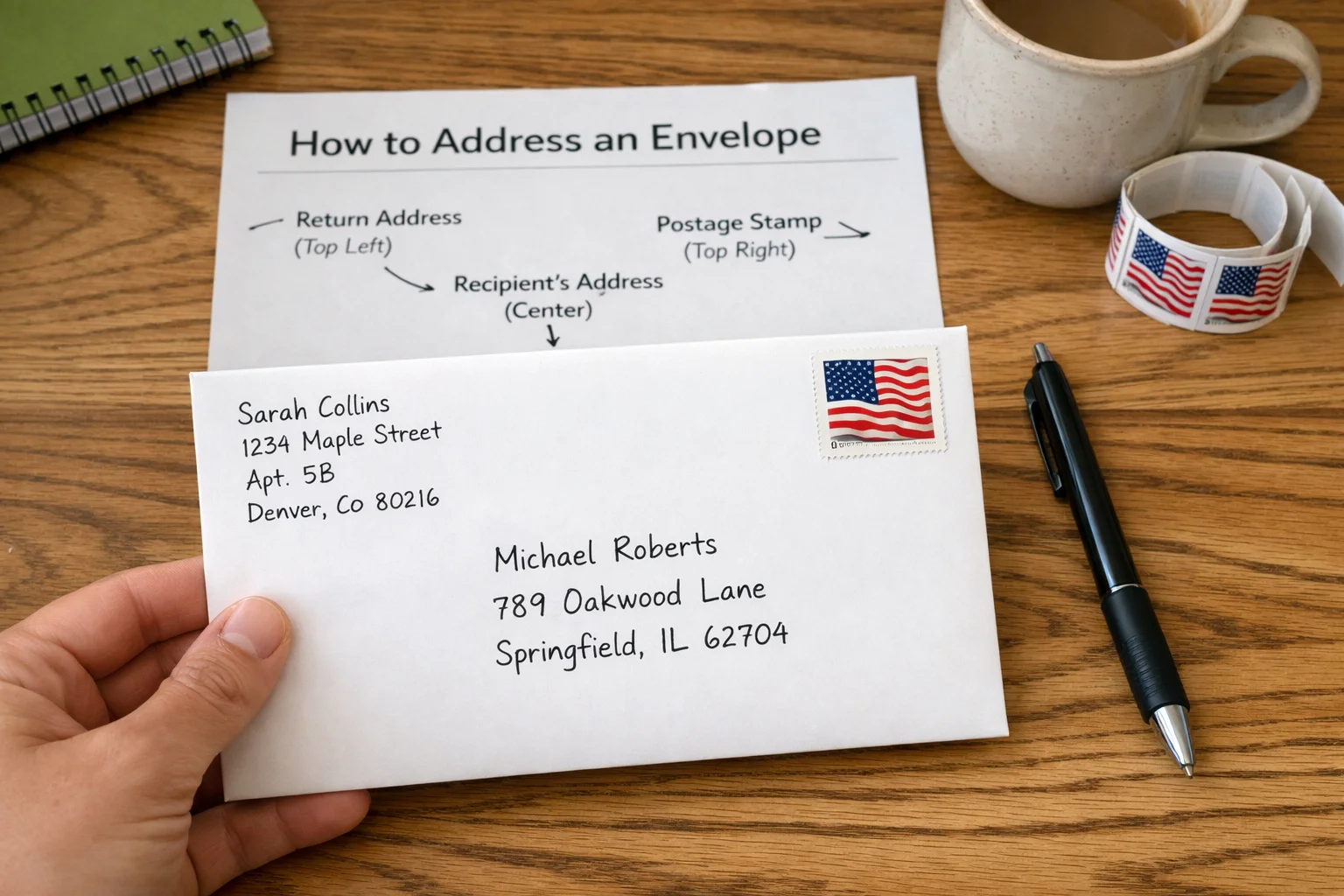
To capture the featured snippet for “how to fill out an envelope,” here is the standard three-part layout:
- The Return Address: Located in the top-left corner.
- The Recipient’s Address: Located in the center of the envelope.
- The Postage: Located in the top-right corner.
Following this specific alignment allows high-speed postal scanners to identify the destination instantly.
Step-by-Step: How to Write an Address on an Envelope
1. The Recipient’s Information (The Centerpiece)
The most critical part of how to write the address in an envelope is the center section. This should be written in clear block letters using dark ink.
- Line 1: Full name of the recipient (include titles like Mr., Ms., or Dr. for formal mail).
- Line 2: Street address (include apartment, suite, or room numbers).
- Line 3: City, State/Province, and ZIP/Postal Code.
2. The Return Address (The Safety Net)
Located in the upper left-hand corner, the return address is your “insurance policy.” If the recipient has moved or the address is incorrect, the postal service uses this information to return the mail to you. Knowing how to handle your own mail is a key part of our first apartment checklist, ensuring you never miss a utility bill or a legal document due to a delivery error.
3. Applying Postage
Always place your stamp in the top-right corner. If you are sending a heavy envelope or international mail, ensure you have calculated the correct weight-based postage to avoid the dreaded “Postage Due” stamp.
How to Address an Envelope for Specific Scenarios
Professional & Business Mail
When learning how to write an address on an envelope for corporate use, you must be more specific. If you are sending a document to a specific person within a large company, use an “Attention” line:
ABC Corporation
Attn: John Doe
123 Business Lane
International Delivery
For mail crossing borders, the bottom line of both the destination and return address must be the name of the country written in all capital letters. This helps international sorters direct the mail to the correct flight path immediately.
Clarity and Precision: Best Practices
To ensure your mail is processed at peak efficiency, keep these tips in mind:
- Print, Don’t Cursive: While elegant, cursive can be difficult for machine scanners to read. Use uppercase block letters for the best results.
- Avoid Punctuation: Modern postal machines prefer “123 Main St” over “123 Main St.” as it reduces the risk of the machine misreading a period as part of a number.
- Contrast is Key: Always use a black or dark blue pen. Light colors or pencils can fade or fail to register on optical scanners.
Just as accuracy is required when mailing a physical letter, academic and professional writing requires you to understand what is a citation to properly credit your sources and maintain the integrity of your work.
Common Mistakes to Avoid
- Omitting the ZIP Code: Without a ZIP or Postal Code, your mail may be diverted to a manual sorting bin, adding days to the delivery time.
- Using the Wrong Ink: Avoid “gel” pens that smear easily if the envelope gets damp in transit.
- Incorrect Labeling: Never place the return address on the back of the envelope; keep everything on the front face for automated processing.