







Reviving a dead car battery is not a guessing game; it is an exercise in basic electrical math. When you turn the key and hear nothing but a rapid clicking sound, your battery lacks the required voltage to engage the starter motor. To fix this, you have to replace that missing electrical energy.
The exact time it takes to fully recharge your vehicle depends entirely on two variables: the total capacity of your specific battery (measured in Amp-hours, or Ah) and the power output of the charger you are connecting to it (measured in Amps).
Understanding this relationship stops you from prematurely unplugging a battery that isn’t ready, or dangerously overcharging one until it cooks. Here is your definitive, structural guide to the electrical mechanics of car batteries, exact charging timelines, and how to safely utilize your vehicle’s alternator after a jump-start.
The Charging Timeline: Matching Amps to Hours
To calculate your timeline, you first need to look at the label on top of your battery. A standard modern car battery typically has a capacity of around 60Ah. This means, in a perfect theoretical environment, it can deliver one amp of power for 60 hours.
When recharging a completely flat 60Ah battery, you divide the capacity by the charger’s output. However, because electrical transfer is not 100% efficient (energy is lost as heat), you must add roughly 10% to 20% more time to the final calculation. Here is how that translates to the equipment in your garage.
The 10-Amp Charger (The Standard Fix: 6-8 Hours)
A dedicated 10-amp wall charger is the undisputed standard for home mechanics. It strikes the perfect balance between speed and maintaining battery health.
- The Math: Pushing 10 amps into a flat 60Ah battery will theoretically take 6 hours. Accounting for resistance and heat loss, the reality is closer to 6 to 8 hours.
- The Verdict: If you discover a flat battery in the evening, hooking it up to a 10-amp smart charger is the most efficient, safe way to guarantee a reliable start the following morning.
The 2-Amp Trickle Charger (The Safe Bet: 15-24 Hours)
A 2-amp trickle charger is painfully slow. By doing the math, it will take a full day (15 to 24 hours) to resurrect a completely flat 60Ah battery.
- The Benefit: While it is useless in an emergency, a slow, gentle charge is the absolute best method for preserving the lead plates inside the battery. Pushing low amperage prevents heat build-up. Trickle chargers are primarily designed for maintenance—keeping a battery topped up on a classic car or a motorcycle that sits in the garage for months at a time.
The 15A+ Fast Charger (The Quick Fix: 2-4 Hours)
Heavy-duty 15-amp or 20-amp fast chargers can force a massive amount of electrical current into the battery, resurrecting a dead vehicle in a matter of hours.
- The Warning: While highly convenient in a breakdown scenario, pushing high amperage generates excessive internal heat. This heat causes the battery acid to boil and the internal lead plates to warp. Relying on fast chargers frequently will drastically reduce your battery’s lifespan and permanently kill its ability to hold a charge.
How Long to Drive After a Jump-Start
If you are stranded in a car park and manage to jump-start your car using jumper cables and a donor vehicle, you must understand the role of your car’s alternator.
The alternator is a mechanical generator driven by your engine’s serpentine belt. Its primary job is to maintain the battery’s voltage while powering the car’s electronics during a drive; it is not designed to resurrect a completely dead battery from zero. If you jump the car and immediately turn the engine off, it will not start again.
- The Rule: You must drive the car continuously for at least 20 to 30 minutes at highway speeds.
- The Mechanics: Idling in your driveway does almost nothing. The alternator requires high engine RPMs (revolutions per minute) to spin fast enough to generate a heavy electrical charge.
- System Isolation: During this 30-minute drive, turn off all unnecessary electrical drains. Turn off the air conditioning, the radio, heated seats, and interior lights. You want to direct every single amp of generated power straight back into the battery block.
If you are a new driver—perhaps just reviewing how long a theory test takes to help a younger sibling prepare—understanding basic breakdown maintenance like isolating your electrical system during a jump-start is just as critical as passing the exam itself.
Modern Tech: AGM and Start-Stop Batteries
If you drive a modern car manufactured in the last decade, especially one featuring automatic “Start-Stop” technology at traffic lights, you likely do not have a standard flooded lead-acid battery. You have an AGM (Absorbent Glass Mat) or an EFB (Enhanced Flooded Battery).
These batteries are built to handle thousands of rapid starts and high electrical loads, but their internal chemistry is highly sensitive.
- The Equipment: You cannot charge an AGM battery with an old, manual analog charger from the 1990s. You must use a modern “smart charger” equipped with a dedicated AGM mode.
- The Timeline: A smart charger reads the battery’s internal resistance and adjusts the amperage output dynamically to prevent damage. Because of this careful, phased approach, expect a completely flat AGM battery to take between 5 to 10 hours to fully recover.
When to Stop Charging (Identifying a Dead Battery)
Sometimes, no amount of charging will fix the problem. Batteries have a finite lifespan, typically lasting between three to five years. As a battery ages, sulfur crystals harden permanently on the internal lead plates—a process called sulfation.
- The 12-Hour Rule: If a standard battery has been sitting on a 10-amp charger for over 12 hours and still will not turn the engine over, it has reached the end of its life.
- Smart Charger Faults: Modern smart chargers run a diagnostic check before pushing power. If the charger immediately flashes a red “Fault” or “Error” light, it means it has detected a dead cell or a severe internal short circuit.
No amount of time or amperage will repair a broken chemical cell. If the battery refuses to hold the charge after a full cycle, it requires professional load testing and an immediate, direct replacement.
FAQs on Charging Car Batteries
Can I leave a car battery charger on overnight? Yes, but strictly only if you are using a modern “smart” or “maintenance” charger. These devices monitor the voltage and automatically drop to a tiny “float charge” the exact moment the battery hits 100%. If you leave an old, cheap manual charger on overnight, it will blindly continue pumping amps into a full battery. This boils the battery acid, ruins the cells, and creates a severe fire hazard from off-gassing hydrogen.
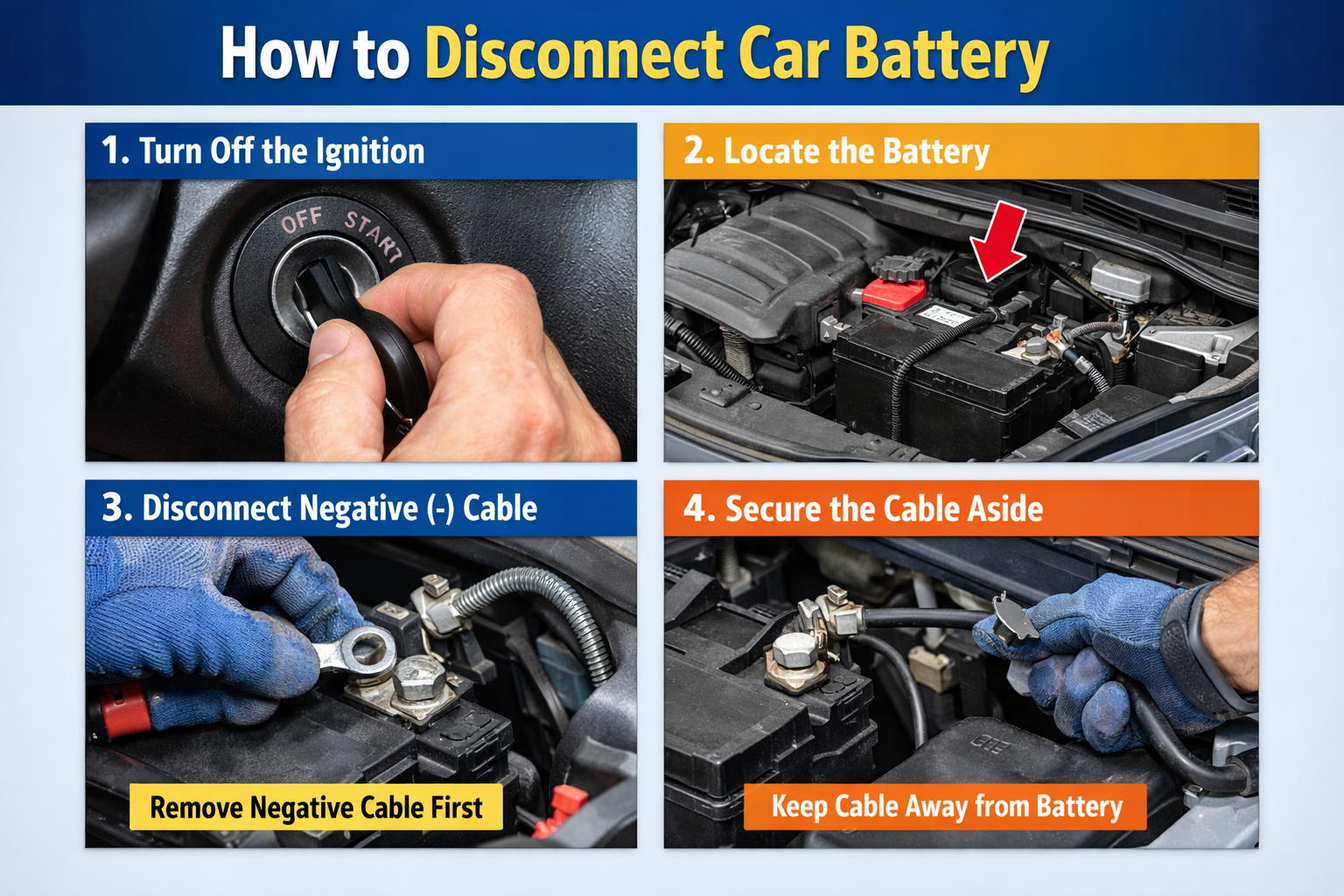
Do I need to disconnect the battery from the car to charge it? If you are using a high-quality modern smart charger, you can usually leave the battery connected to the vehicle while charging. However, as a strict builder’s best practice, it is always safer to loosen the nut and remove the negative (black) terminal cable before clipping the charger on. This completely isolates the battery and guarantees that no accidental power surges can fry your car’s highly sensitive, incredibly expensive ECU (computer).
Charging a car battery requires patience and the right equipment. Match the charger’s amperage to the battery’s capacity, use a 10-amp charger for reliable overnight recovery, drive at high RPMs after a jump-start, and always recognize when a battery’s chemistry is too old to safely accept a charge.