




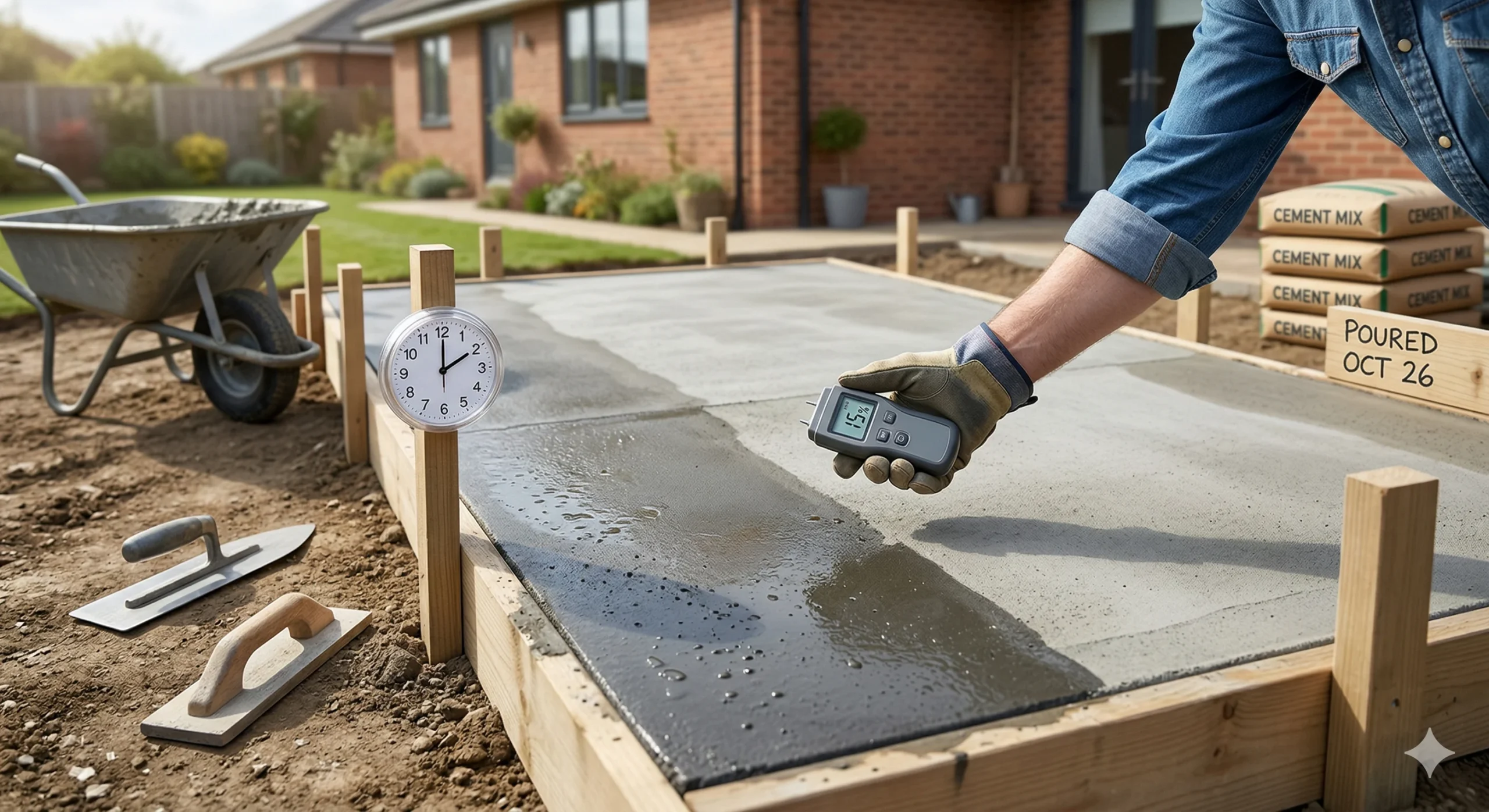
A major misconception in DIY construction is the idea that concrete “dries.” People often assume that the water inside the mix evaporates into the air, leaving a hard slab behind, much like mud drying in the sun. This is chemically incorrect. If the water simply evaporates out of your mix, the slab will fail, crack, and turn to dust.
Concrete does not dry; it “cures” through a continuous, heat-generating chemical reaction known as hydration. During hydration, the cement paste binds with the water to form microscopic crystals that lock the sand and aggregate (gravel) together. Because this is a strict chemical process, it operates on an exact timeline.
Here is your definitive builder’s guide to understanding the concrete curing timeline, the structural mix ratios required for strength, and exactly when it is safe to walk or drive on your new slab.
The Concrete Curing Timeline (When You Can Actually Use It)
The most common question homeowners ask after pouring a new driveway or patio is how long they have to wait before they can use it. The hydration process is rapid at first, then slows down exponentially. Here are the exact structural benchmarks you need to follow.
2 Hours: The Quick-Set Exception
Standard concrete takes a full day to harden, but there is one exception. Specialized quick-set concrete products (often sold in bags specifically for setting fence posts) contain heavy chemical accelerators. These mixes flash-cure and can support light foot traffic or bear the weight of a heavy timber post in just two hours. However, this type of mix is not used for pouring large, flat slabs.
24 to 48 Hours: Initial Set (Walkable)
For a standard concrete pour, the first 24 to 48 hours represent the “initial set.”
- The concrete has hardened enough to safely walk on without leaving footprints.
- Wooden formwork (the temporary framing holding the wet concrete in place) can be carefully unbolted and removed.
- Warning: While it feels solid to the touch, the surface is still highly vulnerable. Dragging heavy tools or dropping items will easily scuff or chip the top layer.
7 Days: Vehicle Loads
After exactly one week, the chemical hydration process has advanced significantly. The slab will have reached approximately 70% of its final compressive strength.
- It is now structurally safe to bear heavy, rolling loads.
- If you have poured a new driveway, this is the benchmark you must wait for before you can safely park a standard domestic car on the surface without risking hidden micro-fractures in the slab.
28 Days: Full Design Strength
In the construction industry, the 28-day mark is the gold standard. After 28 days, the hydration process is considered clinically complete. The concrete has reached 100% of its rated structural design strength and will not undergo any more significant chemical changes.
Concrete Mix Ratios and Strength
The curing timeline only results in a durable slab if the initial chemistry of the mix was correct. You cannot pour a weak mix, wait 28 days, and expect it to hold a car. Concrete strength is determined by the ratio of its three dry ingredients: Cement : Sand : Aggregate.
Here are the three standard structural ratios every builder relies on:
- 1:3:6 Ratio: This is a weaker, high-volume mix used for general garden paths, securing edging stones, and non-load-bearing applications.
- 1:2:4 Ratio: This is the standard structural mix. It provides excellent durability and is used for domestic floors, shed bases, and light garden wall foundations.
- 1:1.5:3 Ratio: This is a heavy-duty, high-strength mix. It contains a much higher concentration of cement binder and is strictly required for applications like driveways or garage floors that will support heavy, moving vehicles.
Getting this mix ratio right from the start is just as critical to the physical integrity of your property as knowing how to reduce the pressure on a boiler—if the baseline mechanics are wrong, the entire system will eventually fail.
How to Protect Curing Concrete
Because hydration relies entirely on the presence of moisture, how you treat the concrete after you pour it is the most critical part of the job. You must protect the chemical reaction.
- Trapping the Moisture: If the sun or wind dries out the top layer of your wet slab, hydration stops instantly, and the surface will shrink and crack. To prevent this, cover the fresh slab entirely with heavy polythene sheeting to trap the evaporating moisture inside. Alternatively, gently mist the surface with a garden hose twice a day. Keeping the concrete artificially moist keeps the chemical hydration process alive.
- Temperature Control: Concrete thrives in moderate weather (ideally above 5°C). You must protect it from freezing temperatures. If the temperature drops below freezing during the first 48 hours, the water trapped inside the wet concrete will freeze. The expanding ice crystals will literally shatter the internal structure of the slab, turning your new concrete into weak, crumbly powder.
When Can You Paint or Seal New Concrete?
If you are planning to apply a decorative finish to your new floor, you must respect the 28-Day Rule.
Homeowners must absolutely avoid applying floor coverings, epoxy sealers, or masonry paint until the full 28-day cure is complete. As concrete cures, it continuously releases invisible moisture vapor into the air. If you roll a layer of thick, waterproof epoxy sealer or masonry paint onto a 10-day-old slab, you will trap that rising moisture vapor beneath the coating. Within a week, the hydrostatic pressure will cause your expensive paint or epoxy to bubble, flake, and peel entirely off the floor.
FAQs on Concrete Curing
Can I speed up concrete curing? Technically, yes. You can use warm water in the mix or add a liquid chemical accelerator during the pour. However, forcing concrete to cure too fast generates excessive internal heat, which almost always leads to severe shrinkage cracks across the surface. In construction, patience yields the strongest slab. Let it cure at its natural rate.
What happens if it rains on freshly poured concrete? Timing is everything. If heavy rain hits immediately after you finish leveling the wet slab, the water will wash the smooth cement cream right off the top, exposing the rough gravel underneath and ruining your finish. However, once the initial set has occurred (usually after 4 to 6 hours) and the surface is hard to the touch, light rain is actually highly beneficial, as it naturally keeps the slab moist and aids the hydration process.
Pouring concrete is heavy work, but the real test is your patience afterward. By mixing the correct structural ratio and fiercely protecting the slab’s moisture content for a full 28 days, you guarantee a solid, crack-free surface that will last for decades.