




If you have ever missed a turning or found yourself facing a blocked route, your first instinct might be to put the car in reverse and back up to where you need to be. But exactly how far are you allowed to reverse on a public road?
Many drivers search for a specific distance—hoping to find a rule that says “you can reverse for 20 meters” or “you can reverse for three car lengths.” However, the UK Highway Code does not give a specific measurement in meters or yards. Instead, the law relies on a situational rule: you must not reverse your vehicle further than is strictly necessary.
Let’s break down exactly what the Highway Code means by “strictly necessary,” the legal penalties for getting it wrong, and the critical safety observation routines you need to follow.
The Highway Code: What Does “Strictly Necessary” Mean?
Because the law does not specify a strict distance, the legality of your reversing manoeuvre depends entirely on the context of the situation and whether a police officer deems your actions safe and justified.
Reversing is inherently more dangerous than driving forward because your visibility is restricted, your vehicle’s steering dynamics change, and pedestrians rarely expect a car to travel backward at speed. Therefore, reversing should only be used as a brief manoeuvre to position your car safely, not as a method of travel.
Valid reasons that are considered “strictly necessary” include:
- Parallel parking into a space on the side of the road.
- Reversing into a driveway or a parking bay.
- Turning around in the road using a safe, multi-point turn (often called a three-point turn).
- Giving way to an obstruction, such as a large lorry or a broken-down vehicle blocking a narrow country lane, requiring you to back up to a passing place.
Invalid reasons for reversing include:
- Reversing back down a street simply because you missed your junction.
- Reversing along a hard shoulder or slip road on a motorway (this is highly illegal and incredibly dangerous).
- Reversing to avoid a traffic jam or a red light.
The Absolute Rule: You must never reverse from a side road onto a main road. Main roads carry faster, heavier traffic. Reversing into this flow blinds you to oncoming hazards. If you need to turn around, you should always pull forward onto the main road, or preferably, reverse into a quiet side road to turn yourself around safely.
Observation and Safety Techniques for Reversing
Whether you are reversing two meters or twenty meters, safety and observation are your primary responsibilities. If you cause an accident while reversing, you will almost always be held at fault.
Here are the strict safety protocols every driver must follow:
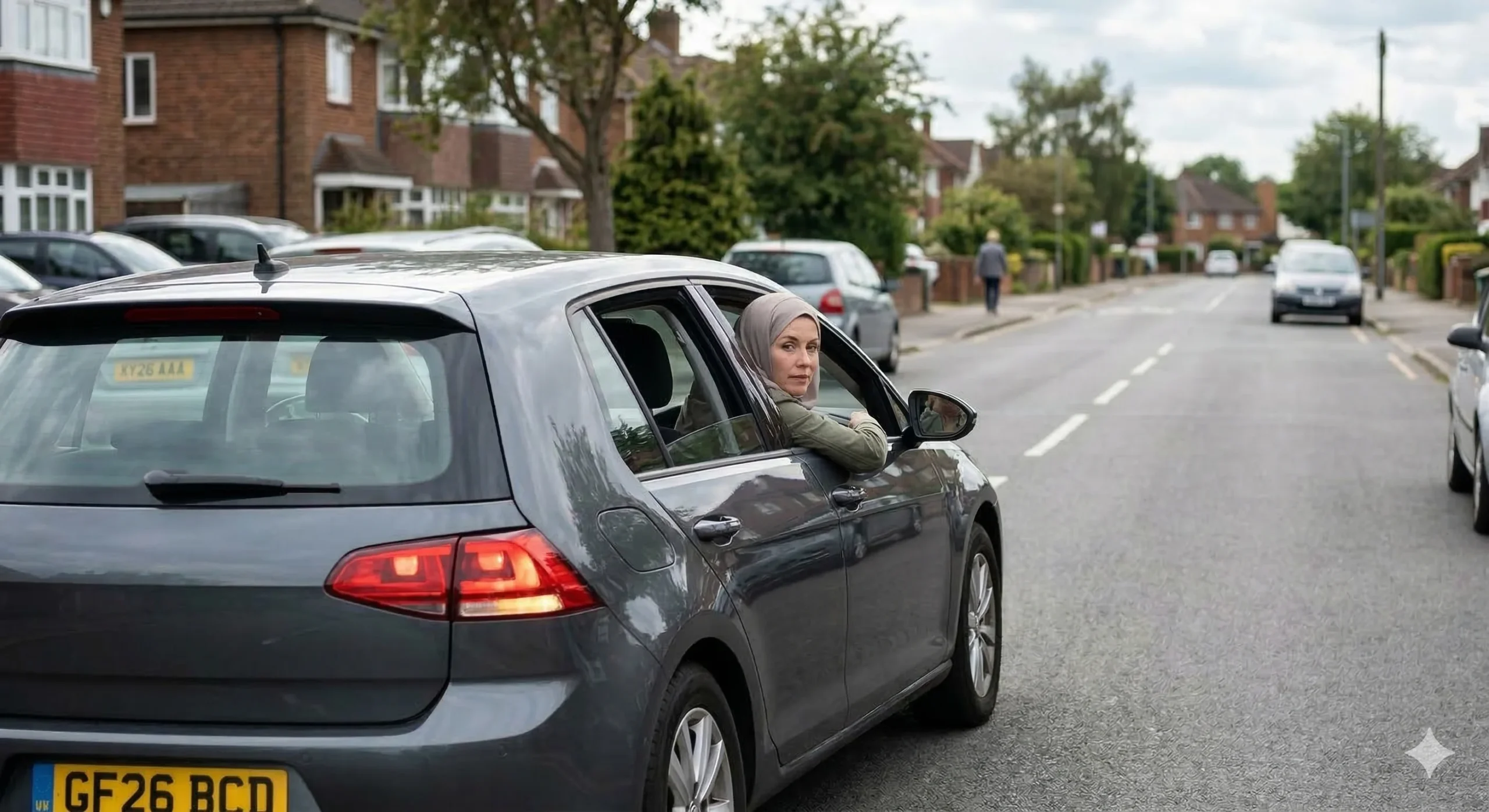
- Look mainly through the rear window: Modern cars are packed with technology, but relying solely on a reversing camera or parking sensors is a dangerous habit (and a critical fault on a driving test). Cameras have blind spots, and sensors can miss narrow objects like posts or pedestrians. You must physically turn your head and look out the back window to see the full picture.
- Check all mirrors and blind spots constantly: Before you even put the car in reverse, do a full 360-degree check. Look over both shoulders. Pedestrians, particularly small children, and cyclists can move into your blind spots in a fraction of a second.
- Watch the front swing: When you turn the steering wheel while reversing, the front of your car will pivot and swing out in the opposite direction. If you are reversing left, the front of your car will aggressively swing out to the right. Always check your front corners to ensure you do not clip a parked car or a passing cyclist.
- Drive at a walking pace: Keep the car moving as slowly as possible. Use clutch control (in a manual) or gentle braking (in an automatic) to keep the speed down. Reversing slowly gives you the critical reaction time needed to stop if someone steps out behind you.
- Use a guide: If you are reversing out of a blind driveway or a tight alleyway and cannot see oncoming traffic, do not risk it. Ask a passenger or a passerby to guide you out safely.
Reversing on a UK Driving Test
If you are a learner driver, your reversing skills will be heavily scrutinized by your examiner. You will be asked to perform one specific reversing exercise during your practical driving test, which could be parallel parking, reversing into a parking bay, or pulling up on the right side of the road and reversing for two car lengths.
Examiners do not just care that you get the car into the space; they care how you do it. The manoeuvre is judged on three strict criteria:
- Control: Can you keep the car moving at a slow, manageable pace without stalling or over-revving?
- Observation: Are you constantly checking your mirrors, looking out the back window, and stopping if a pedestrian or car approaches?
- Accuracy: Can you position the car reasonably close to the curb or safely within the bay lines?
Failing to look around properly before moving backwards is one of the most common reasons for test failures. In fact, mastering these specific observation routines is a major factor when figuring out how long does it take to learn to drive and successfully pass your practical test.
Legal Penalties for Excessive Reversing
If you are caught reversing an excessive distance on a public road, or reversing in a manner that forces other drivers to take evasive action, the police can pull you over.
Because there is no specific “reversing distance” law, you will likely be prosecuted under broader traffic laws. The most common charge is “Driving without due care and attention” (careless driving).
If convicted of careless driving due to a dangerous reversing manoeuvre, you can face:
- Between 3 and 9 penalty points on your driving license.
- An unlimited fine (often tied to your weekly income).
- In severe cases where an accident occurs, you could face disqualification from driving altogether.
Furthermore, if your vehicle’s handling is already compromised—for example, if you are relying on a space-saver and wondering how long can you drive on a spare tire—you should keep any reversing manoeuvres to an absolute minimum for your own safety, as the car’s grip and steering response will be significantly reduced.
FAQs on UK Reversing Rules
Can you reverse into a main road? While reversing from a main road into a side road is legal (and a recommended way to turn around), reversing from a side road directly into a main road is highly dangerous and explicitly advised against by the Highway Code. Always try to drive forward into faster-moving traffic.
Is it illegal to reverse down a one-way street? Yes. Putting your car in reverse does not change the legal direction of traffic flow. If you reverse down a one-way street, you are travelling the wrong way down a designated road, which is a clear traffic offense and highly dangerous to other road users.
Can I reverse on a motorway if I miss my exit? Absolutely not. It is illegal to reverse, cross the central reservation, or drive against the flow of traffic on a motorway, slip road, or hard shoulder. If you miss your exit, you must continue to the next junction to turn around safely.
Ultimately, the rule for reversing in the UK is rooted in common sense. Keep the distance short, keep the speed at a walking pace, and never stop looking around you. Reversing should be a brief adjustment to help you park or turn, not a shortcut to fix a missed junction.