






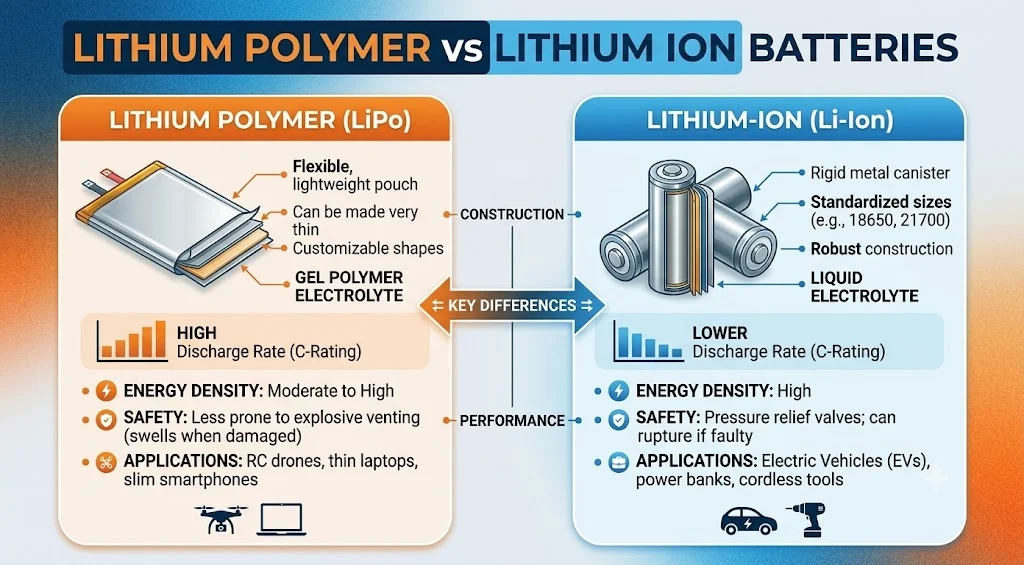
Featured Answer: When comparing lithium polymer (LiPo) vs. lithium-ion (Li-Ion) batteries, the fundamental difference lies in their physical construction and electrolyte state. Lithium-ion batteries utilize a liquid organic electrolyte housed in rigid metallic canisters, offering higher energy density and lower cost per watt-hour. Lithium polymer batteries employ a flexible gel polymer electrolyte encased in lightweight foil pouches, allowing for ultra-thin, customizable form factors and higher discharge rates.
Quick Comparison: Li-Ion vs. LiPo At a Glance
Rechargeable lithium battery chemistry revolutionized mobile electronics, power tools, drones, and electric vehicles. However, selecting between lithium-ion (Li-Ion) and lithium polymer (LiPo) depends heavily on constraints related to weight, space, budget, and power output.
Side-by-Side Technical Comparison
| Technical Property | Lithium-Ion (Li-Ion) | Lithium Polymer (LiPo) |
| Electrolyte Type | Liquid organic solvent | Microporous gel polymer matrix |
| Outer Packaging | Rigid metal canister (Cylindrical / Prismatic) | Soft aluminum-laminated foil pouch |
| Energy Density | High (150 – 260 Wh/kg) | Moderate to High (100 – 200 Wh/kg) |
| Form Factor Flexibility | Standardized shapes (e.g., 18650, 21700) | Highly customizable (ultra-thin, contoured) |
| Discharge Rate (C-Rating) | Lower (typically 1C to 5C continuous) | Very High (up to 50C – 100C+ burst) |
| Average Cycle Life | 500 – 1,000+ full charge cycles | 300 – 500 full charge cycles |
| Cost per Watt-Hour | Lower (due to automated mass production) | Higher (due to specialized manufacturing) |
What is a Lithium-Ion (Li-Ion) Battery?
A lithium-ion battery is a family of rechargeable battery types in which lithium ions move from the negative electrode (anode) to the positive electrode (cathode) during discharge, and back when charging.
Plaintext
       ┌────────────────────────────────────────────────────────┐
       │                 Lithium-Ion Cell                       │
Anode  │  [Graphite]  ──►  (Li+ in Liquid Solvent)  ──►  [Cathode]  │
       └────────────────────────────────────────────────────────┘
How Li-Ion Batteries Work
Inside a standard cylindrical Li-Ion cell (such as the ubiquitous 18650 or 21700 format):
- Electrodes: The anode is made of graphite, and the cathode uses lithium metal oxides (such as $LiCoO_2$ or $LiFePO_4$).
- Liquid Electrolyte: A liquid organic solvent filled with lithium salts allows lithium ions to flow freely.
- Separator: A porous plastic sheet prevents direct electrical contact between the anode and cathode.
- Casing: A rigid metal can holds the internal pressure and protects the liquid electrolyte from leaking.
Advantages and Disadvantages of Li-Ion
- Advantages: High energy density, long cycle life, low self-discharge rate, and significantly lower cost per unit of capacity.
- Disadvantages: Fixed rigid shapes, heavier weight due to steel/aluminum casings, and a risk of volatile thermal runaway if crushed or overcharged.
What is a Lithium Polymer (LiPo) Battery?
A lithium polymer battery (more accurately called a lithium-ion polymer battery) operates on the same electrochemical principles as standard Li-Ion cells, but replaces the free-flowing liquid electrolyte with a solid or gelled polymer composite.
Driven by innovations in hardware and energy technology, LiPo designs have become the standard for modern lightweight consumer devices.
How LiPo Batteries Work
Instead of soaking the internal separator in liquid, LiPo batteries incorporate a microporous polymer gel matrix. Because there is no free liquid that can spill, manufacturers wrap the internal electrode layers inside a flexible heat-sealed plastic-aluminum foil pouch rather than a heavy metal shell.
Advantages and Disadvantages of LiPo
- Advantages: Exceptionally thin profiles (down to 1mm thickness), flexible shape choices, lower overall mass, and extremely high discharge currents.
- Disadvantages: Lower overall energy density per volume, higher manufacturing costs, shorter total lifespan, and vulnerability to physical punctures.
Key Differences: Lithium Polymer vs Lithium Ion
Plaintext
       [ Li-Ion: Rigid Canister ]             [ LiPo: Flexible Pouch ]
     ┌────────────────────────────┐         ┌────────────────────────────┐
     │  Rigid Metal Enclosure     │         │  Laminated Foil Wrapper    │
     │  Liquid Organic Solvent    │         │  Gel Polymer Matrix        │
     │  Higher Energy Density     │         │  High Discharge (C-Rating) │
     └────────────────────────────┘         └────────────────────────────┘
1. Energy Density & Capacity
Lithium-ion batteries hold the advantage in overall energy density. Because liquid electrolytes facilitate efficient ion movement and hard metal walls allow for tight internal packing, Li-Ion cells store more energy per unit of mass and volume ($Wh/kg$) than equivalent LiPo pouches.
2. Form Factor & Weight
Lithium polymer batteries excel in form factor versatility. Because LiPo cells do not require a cylindrical steel case, engineers can design flat, curved, or multi-step pouch configurations tailored to the precise internal geometry of a device chassis.
3. Discharge Rate & Performance
In high-drain applications (such as RC aircraft, racing drones, and heavy-duty power tools), LiPo batteries outshine standard Li-Ion cells. LiPo pouches can deliver sustained high-discharge currents (high C-ratings) without causing excessive internal voltage drops.
4. Safety Profile & Overcharging Risks
Both battery types require built-in Protection Circuit Modules (PCM) or Battery Management Systems (BMS) to prevent overcharging, deep discharging, and short circuits:
- Li-Ion Safety: If internal pressure builds due to thermal runaway, rigid Li-Ion cells rely on top-cap relief vents. If vents fail, catastrophic rupture can occur.
- LiPo Safety: Under thermal stress, LiPo pouches visibly swell (“puff up”) as gas accumulates inside the flexible pouch, providing an early physical warning before rupture. However, puncturing a LiPo pouch with a sharp object can cause immediate ignition.
5. Cost & Manufacturing Complexity
Li-Ion manufacturing is heavily automated globally, driving down unit costs. LiPo manufacturing involves specialized pouch-sealing processes and custom tooling, making them more expensive per milliampere-hour ($mAh$).
Real-World Applications: When to Choose Li-Ion vs. LiPo
To optimize performance and battery health—whether powering an electric vehicle or monitoring mobile device battery consumption on modern smartphones—hardware manufacturers choose battery types based on specific design demands:
- Choose Lithium-Ion (Li-Ion) for:
- Electric Vehicles (EVs) where standardized cylindrical battery arrays (e.g., 21700 cells) provide maximum energy range.
- Laptops, power banks, and cordless power tools that accommodate thicker, structured battery bays.
- Solar energy storage and home backup systems requiring low cost and long cycle life.
- Choose Lithium Polymer (LiPo) for:
- Ultra-thin smartphones, smartwatches, and wireless earbuds where every millimeter counts.
- Drones and RC vehicles requiring low weight and massive instantaneous power output.
- Medical wearables and flexible IoT gadgets.
Frequently Asked Questions (FAQ) About Li-Po and Li-Ion Batteries
Which lasts longer: lithium polymer or lithium ion?
Lithium-ion batteries generally last longer in terms of total charge-cycle lifespan, typically enduring 500 to 1,000+ charge cycles before dropping to 80% capacity. Lithium polymer batteries typically yield 300 to 500 full cycles.
Are lithium polymer batteries safer than lithium ion?
Neither technology is inherently immune to failure. However, LiPo batteries are less prone to explosive pressure buildup because their soft pouch expands when damaged. Conversely, LiPo pouches are more vulnerable to mechanical puncture hazards.
Can I charge a LiPo battery with a Li-Ion charger?
You should only use chargers explicitly designed for your battery chemistry and cell count. While both types operate around nominal voltages ($3.6V – 3.7V$ nominal, $4.2V$ full charge), LiPo multi-cell packs require balanced charging to prevent individual cell overcharging.
What causes a LiPo battery to swell?
LiPo battery swelling (puffing) occurs when the gel electrolyte degrades due to overcharging, deep discharge, high thermal exposure, or physical damage, releasing gas inside the sealed foil pouch. Swollen LiPo batteries must be safely discharged and disposed of immediately.