







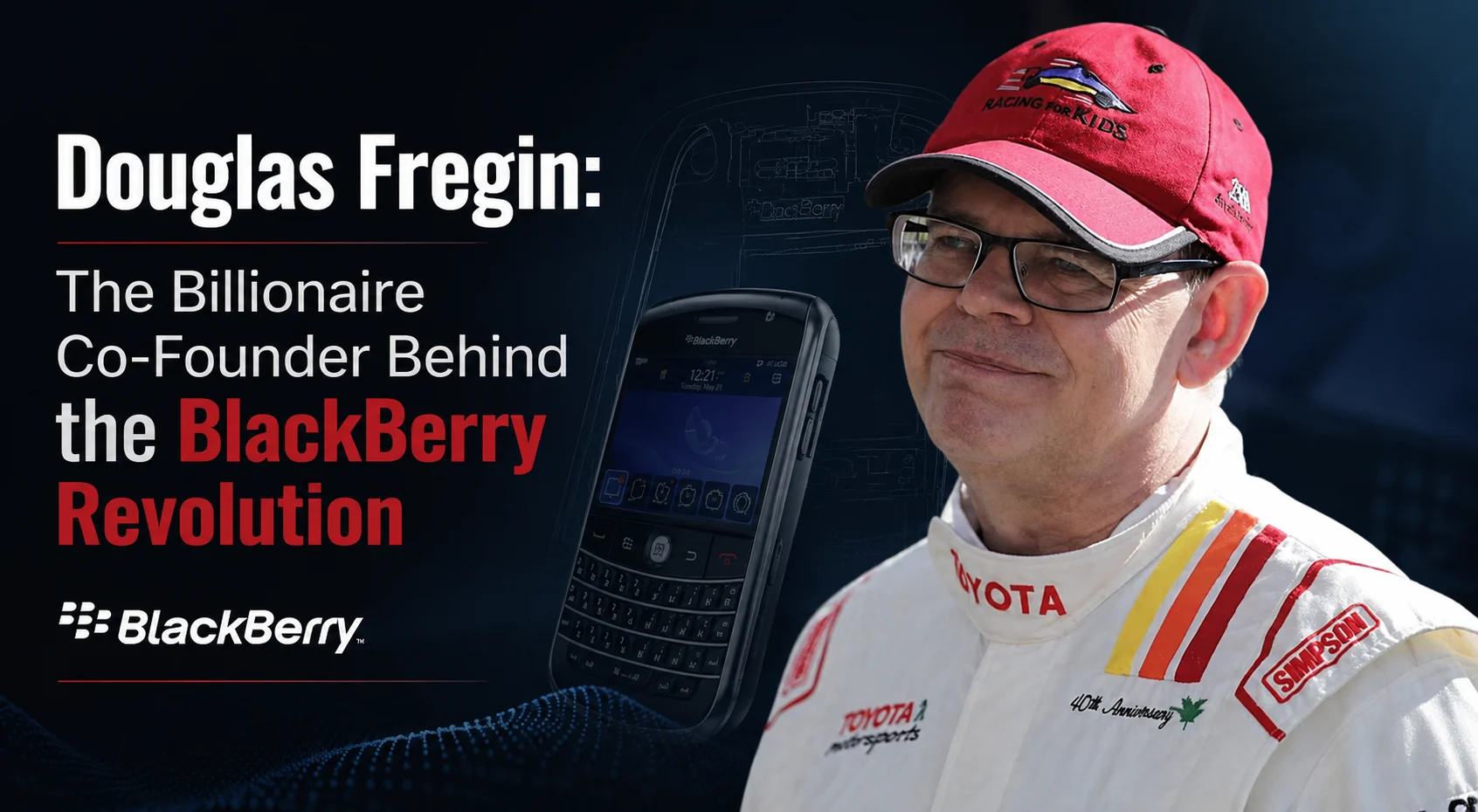
The global technology ecosystem loves stories of charismatic, loud executives who command public stages. When people discuss the meteoric rise and dramatic evolution of Research In Motion (RIM)—the Canadian company that created the BlackBerry—names like Mike Lazaridis and Jim Balsillie instantly dominate the conversation. But behind the scenes, away from investor calls and media scrums, sat the quietly brilliant mastermind who built the physical foundation of the wireless smartphone revolution: Douglas “Doug” Fregin.
Following the global success of the 2023 biographical drama BlackBerry, Fregin suddenly found himself thrust into the mainstream pop-culture spotlight. Played by director Matt Johnson, the movie depicted “Doug from BlackBerry” as a film-loving, headband-wearing, tank-top-sporting office mascot who served as the emotional anchor of the engineering team.
However, the real-world story of Douglas Fregin is vastly different from Hollywood fiction. He was a deeply technical, hyper-focused engineering prodigy whose perfect business timing allowed him to execute one of the most successful exits in corporate tech history.
How Did Douglas Fregin and Mike Lazaridis Meet?
The story of BlackBerry does not begin in a Silicon Valley incubator; it begins in an elementary school classroom in Windsor, Ontario.
Markdown
### How did Douglas Fregin and Mike Lazaridis meet?
Douglas Fregin and Mike Lazaridis met in grade school during childhood. They quickly bonded over a shared obsession with electronics, building gadgets in Fregin's basement and winning regional science fairs together. Their lifelong friendship eventually led them to co-found Research In Motion (RIM) in March 1984.
Fregin pursued a formal education in electrical engineering at the University of Windsor. Shortly after finishing his studies, he teamed back up with Lazaridis to design and develop a specialized video signaling device. Realizing their commercial potential, the young duo secured a $15,000 Ontario New Ventures loan in February 1985.
Working out of small, unglamorous offices in Waterloo, Fregin personally laid down the foundational circuit boards and hardware blueprints that made wireless data transfer possible.
The Emmy and Oscar Breakthrough
Long before the world was typing on physical QWERTY smartphone keyboards, Fregin’s hardware genius revolutionized the film industry. Under his technical direction, RIM developed the DigiSync film reader. This innovative device read keycodes on negative film, dramatically slashing the time required for film editors to handle post-production tasks.
The industry-shifting engineering was so profound that in 1994, Fregin, alongside Eastman Kodak and the National Film Board of Canada, was awarded a prestigious Technology and Engineering Emmy Award. The technology also brought RIM a Technical Achievement Award from the Academy Awards.
Separating Fiction From Reality: The Douglas Fregin Headband Legend
When the BlackBerry movie hit theaters, early RIM employees and tech historians quickly pointed out the massive creative liberties taken with Fregin’s character.
- The Cinematic Myth: Film director Matt Johnson portrayed Doug Fregin as a goofy, cartoonish slacker who wore a prominent headband, hosted office movie nights, and spent his days playing video games.
- The Real Doug: In reality, Douglas Fregin was incredibly reserved, deeply private, and intensely focused on pure engineering hardware. He never wore headbands or tank tops to the office. The character in the film was modified to act as a symbolic representation of the “soul” of 1980s and 1990s startup culture.
What Happened to Douglas Fregin? The Perfect Exit
While many tech founders ride their creations all the way down a crashing slope, Fregin executed a legendary masterstroke of financial timing.
Fregin served faithfully as RIM’s Vice President of Operations for over two decades, keeping the hardware assembly and engineering loops intact. However, in May 2007, he officially retired from his position.
Crucially, his departure happened right around the exact same time Apple launched the very first iPhone. Fregin liquidated his entire 2% ownership stake in Research In Motion, walking away with a cash fortune of $1.3 billion. Because he sold his shares at the absolute peak of BlackBerry’s market dominance, his massive net worth was completely insulated from the eventual market share collapse that destroyed billions in equity for remaining shareholders over the subsequent decade.
Are Douglas Fregin and Mike Lazaridis Still Friends?
The movie implies deep workplace rifts, leaving many to wonder if the two original co-founders ever spoke again.
The answer is a definitive yes. Fregin and Lazaridis have maintained their lifelong childhood friendship and continue to act as major business partners.
In March 2013, the duo pooled their resources to launch Quantum Valley Investments (QVI). QVI is a massive venture capital fund based in Waterloo, Ontario, focused entirely on commercializing breakthroughs in Quantum Information Science. By funding bleeding-edge laboratories and tech startups, Fregin and Lazaridis are working together to build a “Quantum Valley” that aims to do for quantum computing what RIM did for mobile data.
Douglas Fregin Net Worth: How Rich Is He Today?
Because Douglas Fregin is famously reclusive and keeps his personal assets entirely out of the public eye, verifying his exact real-time balance sheet requires looking at his historical cash-outs and private venture assets.
Following his $1.3 billion cash-out in 2007, Canadian Business officially calculated his net worth at $1.72 billion. His personal wealth is anchored securely across private tech equity via Quantum Valley Investments, extensive real estate holdings, and liquid global capital markets. Fregin remains securely placed on the list of Canada’s hidden tech billionaires.
Managing a multi-billion dollar tech empire requires elite operational precision and strict asset management. Within corporate infrastructure, just as venture capitals monitor liquid assets, growing enterprises routinely deploy advanced technology expense management frameworks to audit software ecosystems, eliminate wasteful cloud storage bills, and control ongoing network operational costs.
Philanthropy and Enduring Legacy
Douglas Fregin has used his massive tech fortune to transform the landscape of global scientific research. In 2000, Fregin stepped forward to donate a personal $10 million to help establish the Perimeter Institute for Theoretical Physics in Waterloo. Today, the institute stands as one of the world’s premier hubs for foundational physics research.
On June 19, 2022, the University of Waterloo formally recognized his monumental contributions to engineering, global communication history, and scientific philanthropy by awarding him an Honorary Doctorate of Engineering.
Fregin’s legendary career showcases the power of understanding your own natural talents. For professionals today seeking to discover their unique competitive advantages within complex corporate or technical sectors, reflecting deeply on your learning style by asking what kind of learner am i can help untangle how you process information, layout strategy, and build real-world creations.
Frequently Asked Questions (FAQ)
Did the real Doug Fregin wear a headband?
No. The iconic headband, tank tops, and movie nights were entirely fictional inventions created by director Matt Johnson for the 2023 movie to represent the casual, fun environment of early tech startup cultures. The real Douglas Fregin was quiet, professional, and media-shy.
How much did Doug Fregin make from BlackBerry?
When Douglas Fregin retired as Vice President of Operations in May 2007, he sold his remaining 2% stake in the company for approximately $1.3 billion in cash.
To explore the early engineering systems, wireless infrastructure, and cultural history that Fregin built from the ground up at Research In Motion, you can watch The Evolution of BlackBerry Mobile. This documentary footage is highly relevant as it charts the exact hardware transitions and device rollouts that Fregin directly managed during his historic tenure at the company.