







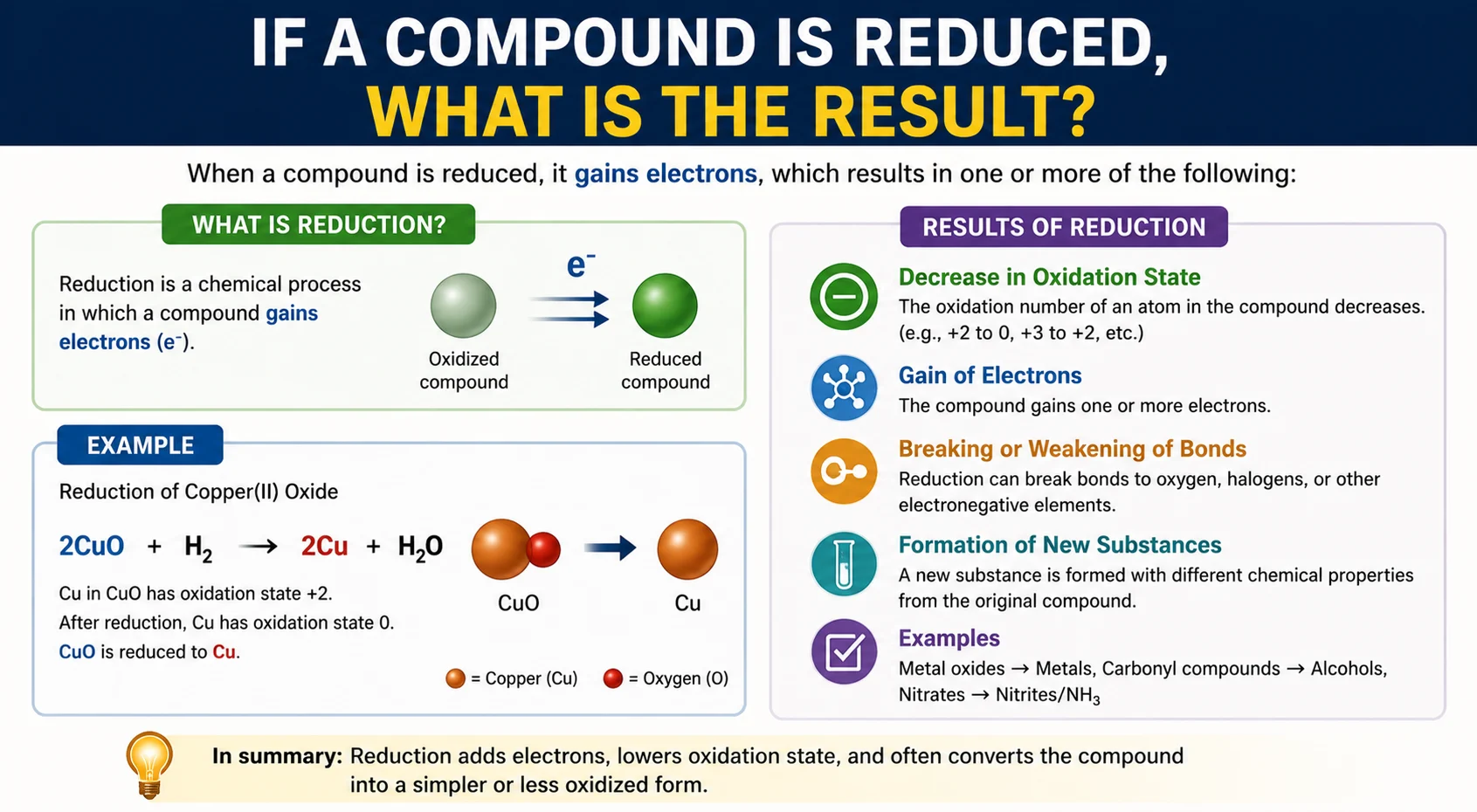
In the world of chemistry, transformation is constant. From the rusting of a backyard fence to the complex energy production within human cells, these changes are driven by the movement of electrons. At the heart of these processes is a concept known as reduction. But if a compound is reduced, what is the result?
Understanding this process is not just for passing exams; it is the key to understanding how our physical world functions.
If a compound is reduced, what is the result in chemistry?
When a chemical compound undergoes reduction, the primary result is the gain of electrons by an atom, ion, or molecule. This process is the mechanical opposite of oxidation. Because electrons carry a negative charge, their addition to a compound leads to a specific set of outcomes:
- Gain of Electrons ($e^-$): The most fundamental result is that the substance being reduced now possesses more electrons than it did before the reaction.
- Decrease in Oxidation State: Because electrons are negative, adding them reduces the “oxidation number” or oxidation state of the atom. For example, if an ion with a $+2$ charge gains two electrons, its oxidation state is “reduced” to $0$.
- A “Redox” Partnership: Reduction cannot happen in a vacuum. If one compound is gaining electrons (reduction), another must be losing them (oxidation). Together, these are known as Redox reactions.
For students looking to improve their science scores and overall academic performance indicator, mastering the concept of redox reactions is a fundamental step in pursuing higher-level chemistry.
The “OIL RIG” Mnemonic: Never Forget the Difference
Chemistry students worldwide use a simple mnemonic to keep these two twin processes straight. It is the “OIL RIG” method:
- Oxidation Is Loss (of electrons).
- Reduction Is Gain (of electrons).
If you are ever confused about whether a compound is being reduced or oxidized, simply look at the electron flow. If the compound is “taking” electrons from its neighbor, it is being reduced.
Understanding Redox Reactions: The Full Picture
In a redox reaction, the compound that is being reduced is often referred to as the oxidizing agent. This can be a bit confusing at first! It is called the oxidizing agent because, by taking electrons for itself, it causes the other compound to be oxidized.
A Classic Example: Copper and Zinc
Consider a simple reaction where copper ions ($Cu^{2+}$) react with solid zinc ($Zn$):
$$Zn + Cu^{2+} \rightarrow Zn^{2+} + Cu$$
In this scenario:
- The Copper ($Cu^{2+}$) gains two electrons. It is reduced to solid copper ($Cu$).
- The Zinc ($Zn$) loses two electrons. It is oxidized to zinc ions ($Zn^{2+}$).
The result of the copper being reduced is a shift from a dissolved ion state to a solid metal state. Just as chemistry helps us understand these electronic shifts, it also provides the tools to differentiate materials in the physical world, such as knowing how to tell if a diamond is real based on its unique physical and chemical properties.
Common Examples of Reduction in Real Life
Reduction is not just a laboratory phenomenon; it is happening around you every second.
1. Cellular Respiration
Inside your body, your cells use a series of redox reactions to produce energy. During metabolism, oxygen is reduced to form water. This gain of electrons is what allows your body to harvest the energy stored in the food you eat.
2. Metallurgy and Mining
Most metals are not found in their pure form in nature; they exist as oxides. To get pure iron for construction, for instance, iron ore must be “reduced” in a blast furnace. By removing the oxygen and forcing the iron ions to gain electrons, we result in the pure metal used to build skyscrapers.
3. Battery Power
Every time you use your smartphone, you are relying on reduction. Inside the lithium-ion battery, lithium ions move and are reduced at the cathode during discharge, creating the flow of electricity that powers your device.
Conclusion: Why Reduction Matters
So, if a compound is reduced, what is the result? The result is a more “electron-rich” version of that compound with a lower oxidation number. Whether it’s creating the metal for a car or the energy for a heartbeat, reduction is the silent force that drives the movement of life and technology. Understanding this gain of electrons is the first step toward mastering the molecular language of the universe.