







If you have stepped onto a car dealership lot recently, you have likely heard the term “CVT” mentioned by every sales representative. As of April 2026, the Continuously Variable Transmission has become the dominant choice for manufacturers aiming to balance power with increasingly strict global fuel efficiency standards.
But what is a CVT transmission exactly, and how does it differ from the traditional gearbox you’ve used for decades? Whether you are car shopping or just noticed a strange “drone” coming from your engine bay, this comprehensive guide breaks down everything you need to know about gearless driving.
CVT vs. Traditional Automatic: At a Glance
| Feature | Traditional Automatic | CVT Transmission |
| Gears | Fixed set (e.g., 6-speed, 8-speed) | Zero fixed gears (Infinite ratios) |
| Shifting | Noticeable “steps” or surges | Seamless, fluid transition |
| Fuel Economy | Good | Excellent (Standard for Hybrids) |
| Maintenance | Standard ATF changes | Specialized CVT fluid required |
1. The Mechanics: How a Gearless System Drives Your Car
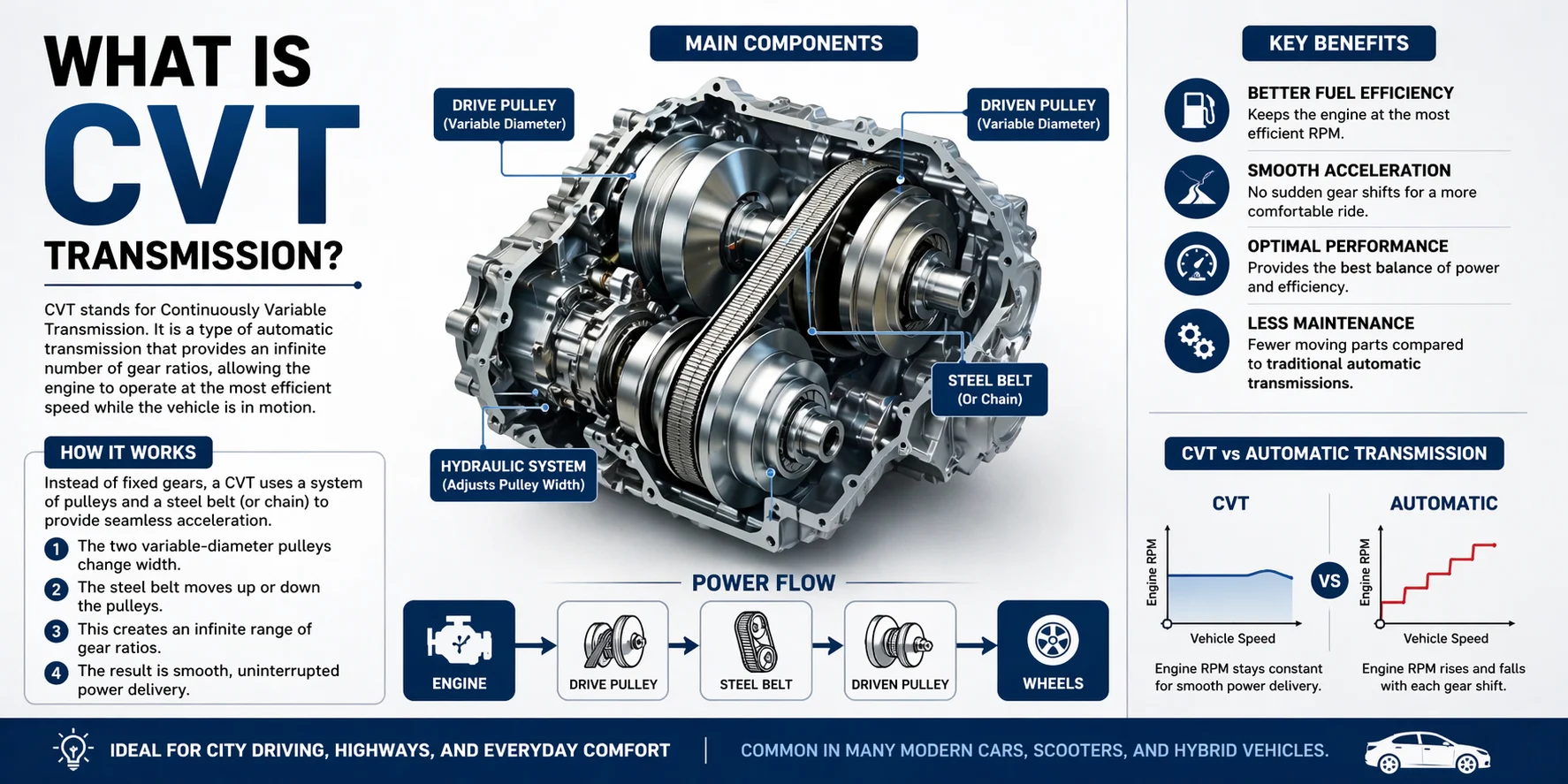
Unlike a standard automatic transmission that uses a complex web of planetary gears and clutches, a CVT operates on a remarkably simple principle of physics.
The Two-Pulley System
At the heart of a CVT are two V-shaped pulleys—one connected to the engine (input) and one connected to the wheels (output). These pulleys are linked by a high-strength steel belt or chain.
The magic happens when the pulleys change their width. When one pulley gets narrower, the belt moves higher up on the cone, creating a larger diameter. Simultaneously, the other pulley gets wider. By constantly adjusting these diameters, the transmission can create an infinite range of “gear ratios.”
The 2026 Technical Evolution
In the past, CVTs were criticized for being “weak” or prone to slipping. However, by April 2026, the industry has shifted toward high-torque steel chains (as seen in Subaru and Honda models) and sophisticated hydraulic pressure systems. This allows modern CVTs to handle larger engines and even light towing, tasks that would have shredded a CVT belt just a decade ago.
2. Why Use a CVT? The Benefits for 2026 Drivers
The primary reason manufacturers like Toyota, Nissan, and Honda have gone “all-in” on CVTs is efficiency.
- Optimal Power Band: A traditional engine has a “sweet spot” (RPM) where it produces the most power or gets the best mileage. A CVT can keep the engine at that exact RPM indefinitely while the car accelerates.
- Smoother Commutes: Because there are no physical gears to shift, there is no “shift shock”—the slight lurch you feel when an automatic car moves from first to second gear.
- Lightweight Design: CVTs are smaller and lighter than 10-speed automatics, which helps improve the overall weight distribution of the vehicle.
3. The “Rubber Band Effect” and Driving Feel
One common complaint from drivers switching to a CVT is the “rubber band effect.” This happens when you press the gas, the RPMs spike and stay high, and the car’s speed gradually catches up.
To combat this, 2026 models now use “Step-Shift” programming. The car’s computer artificially drops the RPMs at specific intervals to mimic the sound and feel of a traditional gear change, making the driving experience feel more natural to those used to older gearboxes.
4. Maintenance and Reliability: Keeping Your CVT Alive
A CVT is a precision instrument, and it requires specific care. You cannot treat it like a traditional automatic.
The Importance of Fluid
CVT fluid is not just a lubricant; it is a hydraulic fluid that provides the friction necessary for the belt to “grip” the pulleys. Using the wrong fluid can cause the belt to slip, leading to catastrophic failure. If you are checking your own vehicle, knowing what color is cvt transmission fluid is your first line of defense in spotting contamination or overheating.
Connected Maintenance
In the modern era, car care is becoming digitized. Many 2026 service centers now utilize what is ops technology to monitor transmission health remotely. These operational systems track the “thermal breakdown” of your transmission fluid in real-time, alerting you via a smartphone app before a minor leak becomes a multi-thousand-pound repair.
5. Is a CVT Right for You?
If you are a daily commuter looking for the best possible miles per gallon (MPG) and a smooth, effortless ride, a CVT is arguably the best choice on the market today. However, if you are an enthusiast who enjoys the mechanical “click” of a gear change or someone who needs to tow heavy trailers regularly, you may still prefer a traditional torque-converter automatic or a dual-clutch transmission (DCT).
The Bottom Line
The CVT transmission has evolved from a misunderstood “budget” option into the backbone of the modern hybrid and fuel-efficient internal combustion engine (ICE) market. By understanding how it works and staying on top of specialized maintenance, you can enjoy hundreds of thousands of miles of seamless driving.