







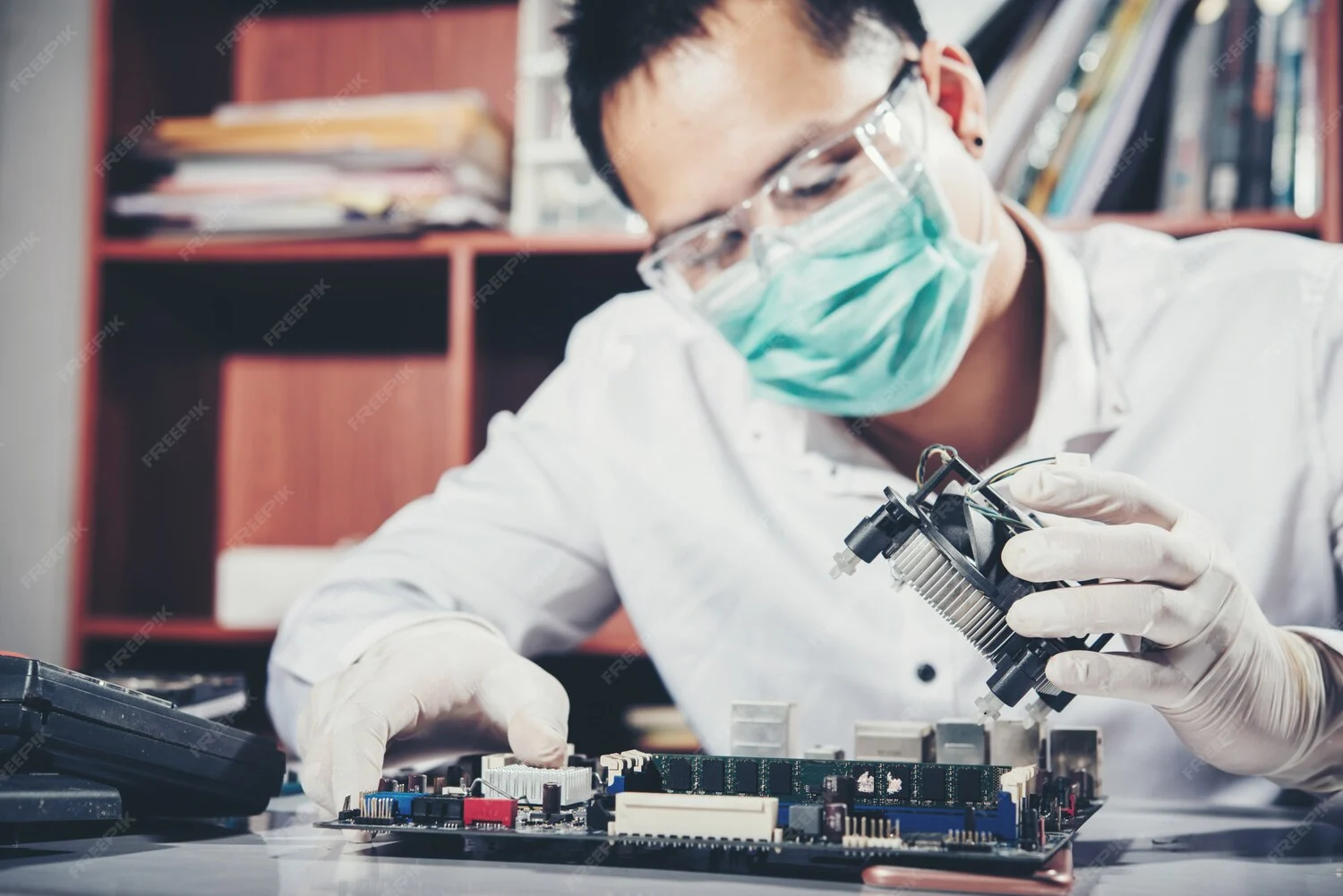
Producing modern electronics requires a staggering level of precision. Microchips, circuit boards, and semiconductors contain microscopic pathways that must remain completely unobstructed. Even a single speck of dust can ruin a component, rendering an entire device useless. This makes the environment where these components are built just as important as the materials used to build them.
Types of Contaminants and Their Sources
Microscopic threats come in many forms. Facilities must identify what they are fighting before they can implement effective defenses. Contaminants generally fall into three main categories.
Particulate Contaminants
Particulates are solid particles suspended in the air. Dust, skin flakes, hair, and clothing fibers are incredibly common. Humans are actually the largest source of particulate contamination in any facility. A stationary person sheds thousands of particles every minute, and movement multiplies that number rapidly. Equipment wear and tear also generates tiny metal or plastic shavings that float through the workspace.
Chemical Contaminants
Chemicals can easily disrupt delicate electronic pathways. These contaminants take the form of vapors, gases, or liquid residues. Common sources include cleaning solvents, adhesives, and lubricants used on manufacturing machinery. Off-gassing from plastics and building materials can also introduce harmful chemical vapors into the environment.
Biological Contaminants
Biological contaminants include bacteria, fungi, and spores. While they are a larger concern in pharmaceutical manufacturing, they still pose a threat to electronics. Biological matter can create organic films on sensitive surfaces. This often leads to corrosion or unwanted electrical resistance.
Impact of Contamination on Product Quality
The consequences of poor contamination control are severe. Microprocessors feature components measured in nanometers. A human hair is enormous by comparison. When foreign material interferes with these structures, the results are almost always negative.
First, contamination causes massive yield loss. Yield refers to the percentage of manufactured products that actually function correctly. High yields mean high profitability. When particles cause short circuits or block connections, those components fail testing and must be discarded. Scraping expensive materials directly hurts the bottom line.
Second, contamination destroys long-term product reliability. Sometimes a contaminated chip passes initial quality testing but fails after a few months of use. This is often due to chemical residues causing slow corrosion over time. Latent defects lead to product recalls, warranty claims, and severely damaged consumer trust.
Cleanroom Technology and Protocols
To combat these microscopic threats, manufacturers build highly specialized environments known as cleanrooms. A cleanroom controls airborne particles, temperature, humidity, and air pressure to exact specifications.
Advanced Filtration Systems
The backbone of any cleanroom is its filtration system. High-Efficiency Particulate Air (HEPA) filters and Ultra-Low Penetration Air (ULPA) filters continuously scrub the air. These systems force air downward in a smooth, uniform flow. This laminar airflow catches floating particles and pushes them out through vents near the floor, preventing them from settling on work surfaces.
Gowning and Personnel Protocols
Because humans are the main source of particles, strict gowning protocols are mandatory. Workers must wear specialized “bunny suits” made of non-linting materials. This gear includes hairnets, face masks, gloves, and shoe covers. Facilities also use air showers at the entrance to blow loose particles off workers before they step onto the manufacturing floor.
Best Practices for Contamination Control
Having the right technology is only half the battle. Facilities must enforce rigorous daily practices to maintain their strict environmental standards.
Training is the most critical practice. Every employee must understand how their movements affect the environment. Walking too fast can disrupt laminar airflow, while scratching an itch can release thousands of skin cells. Continuous education ensures that workers respect the fragility of the cleanroom.
Regular cleaning routines are also vital. Workstations require wiping with approved, lint-free cloths and specific solvents. For specialized components, advanced methods are necessary. For example, some facilities use fluoride ion cleaning to remove deep-seated oxides and residues from specific metallic parts before they undergo delicate coating processes.
Finally, continuous monitoring guarantees that the protocols are actually working. Particle counters constantly sample the air to ensure the room meets its designated ISO classification level. If particle counts spike, the system alerts managers so they can immediately halt production and identify the source of the breach.
Conclusion
As consumer demand grows for smaller, faster, and more powerful devices, the margin for error in manufacturing shrinks. The pathways on microchips will only continue to narrow. This means that particles previously considered harmless will soon become critical threats.