







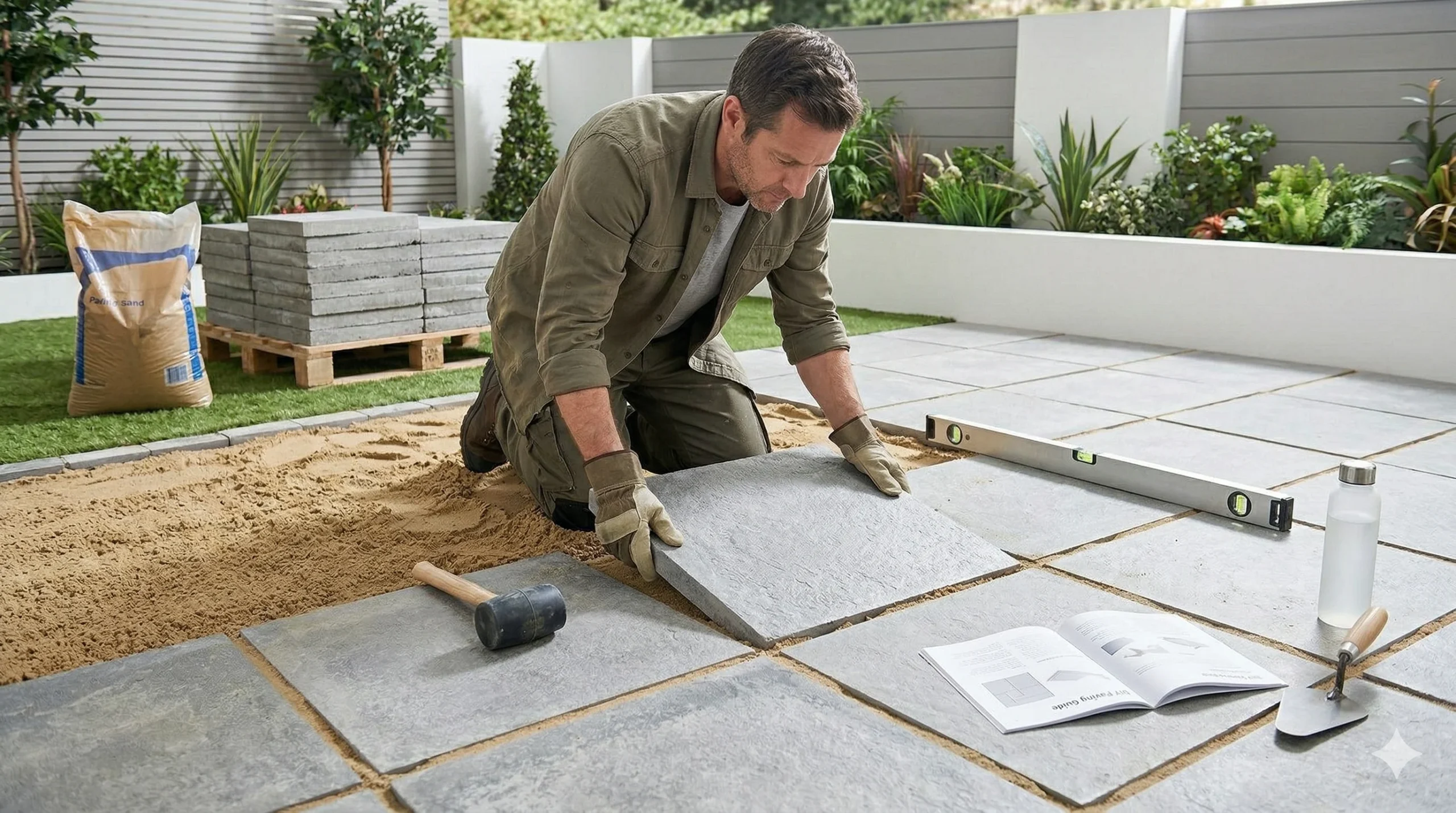
A beautiful, flat patio completely transforms the visual appeal of your home. But when it comes to laying paving slabs, the foundation matters far more than the aesthetics. If you just throw some slabs on dirt, they will sink and become uneven after the very first rain.
A professional patio is built from the ground up. In “Build Mode,” we don’t take shortcuts. A solid patio requires accurate digging, proper compaction, the correct mortar mix, and a precisely calculated slope so rainwater doesn’t pool against your house’s foundation.
Whether you are building a small pathway or a massive outdoor entertainment area, here is the complete, step-by-step builder’s guide to laying paving slabs perfectly.
Essential Tools and Materials for the Job
Before starting the job, make sure you have everything ready on-site. Once the mortar is mixed, you will not have time to go looking for tools.
The Materials:
- Paving Slabs: Natural stone, porcelain, or concrete.
- MOT Type 1 Hardcore: This is crushed stone and dust that locks together to form a solid, immovable sub-base.
- Sharp Sand and Portland Cement: For your mortar bed. Sharp sand has larger, grittier particles than standard building sand, giving the bed structural strength.
- Jointing Compound: To fill the gaps between the slabs once finished.
The Tools:
- Spade and shovel for digging.
- Plate compactor (wacker plate) – you can easily hire this for the day.
- Wheelbarrow and cement mixer (or a mixing board).
- Long spirit level (at least 1200mm or 4-foot).
- Heavy rubber mallet (never use a metal hammer on slabs).
- Tape measure, string lines, and wooden pegs.
- Trowel for handling the mortar.
Step 1: Digging and Compacting the Sub-Base
A patio is only as strong as the ground beneath it. The biggest mistake people make here is digging too shallow.
You need to calculate the depth. You must dig down far enough to accommodate:
- 100mm of compacted Type 1 hardcore sub-base.
- 30mm to 40mm of mortar bed.
- The thickness of your paving slab (let’s say 30mm). Total Dig Depth = ~160mm below your desired finished patio height.
- Mark the Area: Use wooden pegs and a string line to mark the exact perimeter of your new patio. Use the 3-4-5 triangle method with your tape measure to ensure the corners are perfectly square.
- Dig it Out: Remove the topsoil and grass down to your calculated depth. Try to keep the bottom of the trench relatively flat.
- Add the Hardcore: Pour in the MOT Type 1 hardcore. Spread it evenly with a rake.
- Compact It: Run the plate compactor over the hardcore several times. The vibration locks the crushed stones together. By the time you are done, the surface should be hard enough to walk on without leaving any footprints. The foundation must be solid; otherwise, the weight of the slabs will not settle correctly.
Step 2: Mixing the Perfect Mortar Bed
The mortar bed is the glue that holds your slabs in place and absorbs any minor weight distribution shifts. The standard ratio for a patio mortar bed is 4 parts sharp sand to 1 part cement.
You want a “semi-dry” or “damp earth” consistency. When you squeeze a handful of the mix in your glove, it should hold its shape without dripping excess water. If it is too wet, the heavy slabs will sink straight to the bottom. This requires the same attention to ratios and moisture control as learning how to make concrete for heavier structural footings.
Spot Bedding vs. Full Bedding:
- Spot Bedding: Placing five dabs of mortar (one on each corner, one in the middle) is an older method. While it saves material, it leaves hollow voids under the slab. Water can collect in these voids, and in freezing weather, the ice will expand and crack the slab.
- Full Mortar Bed: This is the professional standard. Spread a full, even layer of mortar (about 30mm thick) across the entire footprint of the slab. This supports 100% of the slab’s weight and prevents water pooling underneath.
Step 3: Laying the Slabs and Getting the “Fall” Right
This is the most technical phase. Your patio should look completely flat, but in reality, it needs a slight tilt. This is called the “fall,” and it ensures rainwater drains away from your house.
The 1 in 60 Rule: For every 60 units of distance, the patio should drop by 1 unit. Practically, this means for every 1 meter (1000mm) of patio moving away from your house, the level should drop by about 17mm.
- Set Your String Lines: Set up string lines across your working area that incorporate this slight 1 in 60 slope. This gives you a visual guide to follow.
- Start at the Highest Point: Always start laying slabs from the highest point (usually right against the house wall) and work your way outwards and downwards.
- Place the Slab: Lay your full mortar bed for the first slab. Carefully lower the slab into position. Never drop it.
- Tap it Down: Use your rubber mallet to gently tap the slab down into the mortar. Hit the corners and the center to bed it evenly.
- Check the Level: Place your long spirit level across the slab. The bubble should sit slightly off-center (showing the fall) in the direction of your drainage, but perfectly centered when checking the horizontal line parallel to the house.
- Leave a Gap: As you place the next slab, leave a joint gap of about 10mm between them. You can use small wooden spacers or plastic tile spacers to keep the gaps consistent.
Step 4: Pointing and Sealing the Joints
Once all the slabs are laid, you need to walk away. Leave it alone. Do not step on the patio for at least 24 to 48 hours. The cement in the mortar needs this time to cure and lock the heavy stones securely. If you walk on them too early, the slabs will rock, break the mortar bond, and you will have loose paving forever.
After 48 hours, it is time to fill the 10mm gaps. This is called “pointing.”
- Traditional Pointing: You can mix a dry batch of 3 parts building sand to 1 part cement, brush it into the joints, and use a jointing tool to pack it down tightly. The natural moisture in the air and ground will slowly cure it.
- Brush-in Jointing Compound: This is the modern, faster alternative. It comes in vacuum-sealed tubs. You simply wet the patio, brush the compound into the gaps, and it hardens upon contact with the air. It expands slightly to fill every void and prevents weeds from growing through.
If you are doing a complete garden renovation, timing is everything. Once your patio is cured and finished, you can move on to the soft landscaping, such as learning how to lay turf like a professional alongside your new paving, creating a stunning contrast between the sharp stone edges and the fresh green grass.
Frequently Asked Questions
Can I lay paving slabs directly on soil or dirt? Absolutely not. Topsoil is organic and highly compressible. When it rains, the soil turns to mud. Your heavy paving slabs will immediately sink, shift, and become uneven, creating dangerous trip hazards. A hardcore sub-base is 100% non-negotiable for a patio that lasts.
How long should you stay off new paving slabs? You must keep all foot traffic off the newly laid slabs for a minimum of 24 to 48 hours. This allows the mortar bed underneath to undergo the chemical curing process. Walking on it prematurely breaks the microscopic bonds in the cement, resulting in loose, wobbly slabs.
Do I need a membrane under my patio? Yes, it is highly recommended to lay a weed-suppressant geotextile membrane down before you add your Type 1 hardcore. This stops the hardcore from mixing into the soft soil below over time, and it provides an extra layer of defense against deep-rooted weeds trying to push up through your paving joints.