






Sardiyon ke mausam mein agar achanak shower ka paani thanda ho jaye ya radiators kaam karna band kar dein, toh panic hona natural hai. Most people immediately assume that their expensive heating system is completely broken. But the truth is, the most common cause for a combi boiler shutting down is simply a lack of water pressure.
Boiler ka pressure drop hona ek normal maintenance issue hai. Modern heating systems are sealed, meaning the water inside circulates in a closed loop. Over time, tiny amounts of water evaporate, or air is bled out of the system, causing the overall pressure to drop. When it drops too low, the boiler’s internal safety sensors trigger an emergency shutdown to prevent the pump from running dry and burning out.
The good news? You do not need to pay a professional call-out fee for this. Increasing the pressure (also known as “topping up” or “re-pressurizing”) is a safe, simple 5-minute task that any homeowner can do. Let’s walk through exactly how to get your system back online.
The “Sweet Spot”: Understanding Boiler Pressure
Before turning any valves, you need to understand what you are actually looking at. On the front of your boiler, you will see a pressure gauge. This might be a traditional dial with a needle and green/red zones, or a modern digital screen.
The pressure is measured in “bar.”
- The Cold Sweet Spot (1.0 to 1.5 bar): When your heating system is completely off and the radiators are cold, the gauge should sit comfortably between 1.0 and 1.5 bar.
- The Hot State (1.5 to 2.0 bar): When the boiler fires up and heats the water, thermal expansion occurs. Paani garm hone par expand hota hai, so it is completely normal for the pressure gauge to rise by about 0.5 bar while the heating is on. This is why we always check and adjust the pressure when the system is cold.
Symptoms of Low Boiler Pressure
Aapko kaise pata chalega ke problem pressure ki hi hai? Your system will usually give you a few clear warning signs:
- The pressure gauge needle has dropped below 1.0 bar (often resting in the red zone or at 0).
- Your radiators are lukewarm or completely cold, especially on the upper floors of the house (the pump doesn’t have enough pressure to push water upstairs).
- You have no hot water coming from your taps.
- The boiler is displaying a flashing fault code (for example, F22 on Vaillant boilers, or E119 on Baxi models).
Step-by-Step: How to Increase Boiler Pressure
Here is the exact, step-by-step process to top up the system. We are going to enter “Build Mode” here—take it slow, follow the steps, and watch the gauge.
Step 1: Turn Off and Cool Down
Safety comes first. Turn off your boiler at the main switch or the thermostat. Give the system at least 30 minutes to an hour to cool down if it was recently trying to run. Adding freezing cold mains water into a piping hot boiler can cause thermal shock to the internal heat exchanger, potentially cracking it.
Step 2: Locate the Filling Loop
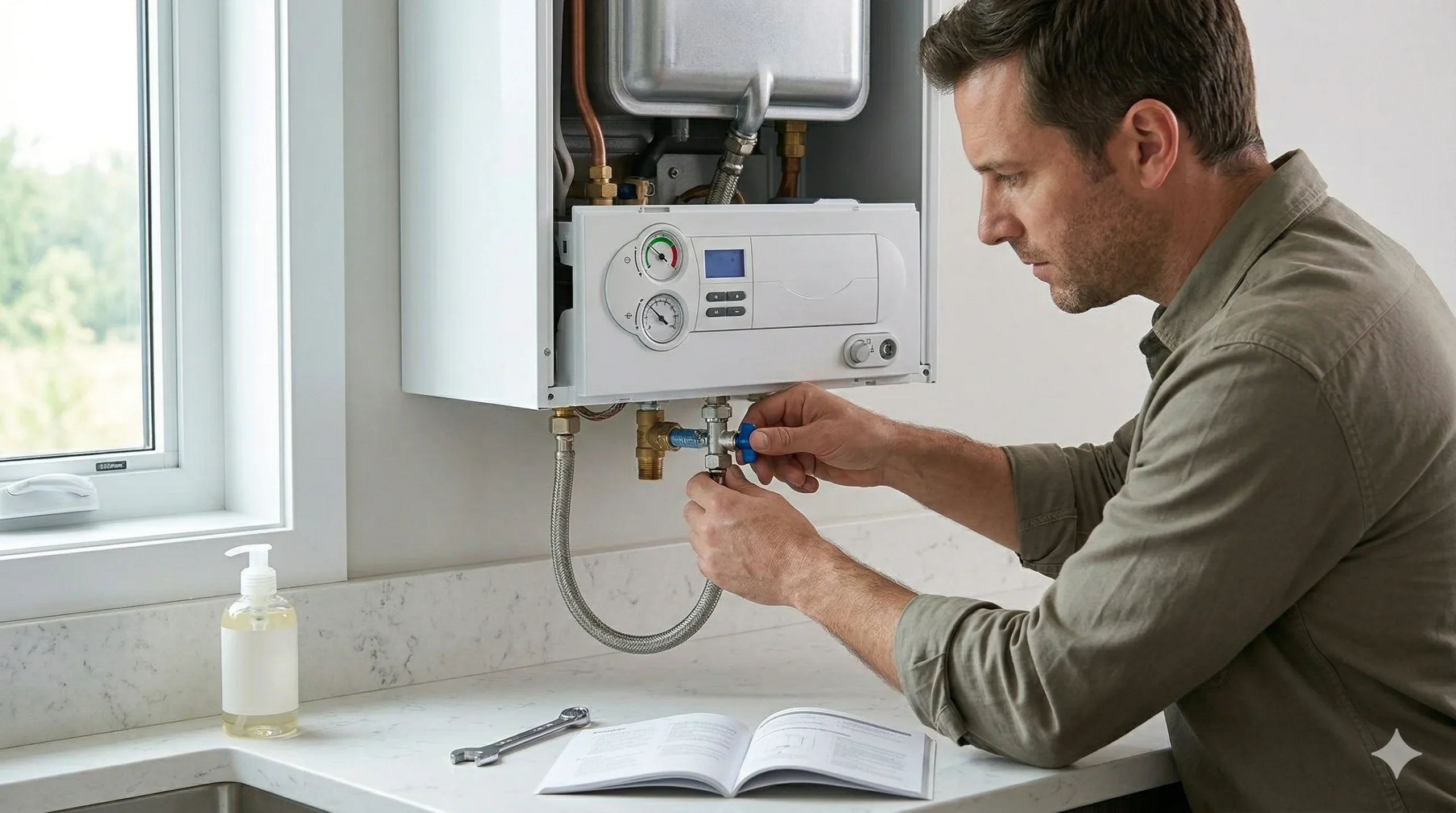
Look directly underneath your boiler casing. You are looking for the “filling loop.” This is the temporary bridge that connects your home’s cold water mains supply to the sealed heating circuit.
In most modern setups, this looks like a flexible, silver braided metal hose with two small valves (taps) on either end. The handles on these taps are usually black or blue. Some modern Worcester Bosch boilers have an internal filling key instead of a hose, which requires pushing a plastic lever, but the principle remains exactly the same.
Step 3: Open the Taps Slowly
This is where we actually let the water in.
- Turn the first tap (it doesn’t matter which one) 90 degrees so it aligns with the pipe. You won’t hear anything yet.
- Now, slowly open the second tap. As you turn it, you will immediately hear the distinct rushing sound of cold water entering the heating system.
Step 4: Watch the Gauge and Close the Taps
Do not walk away. This process happens very fast. Keep your eyes locked on the pressure gauge dial.
- Watch the needle rise steadily from 0 or 0.5 bar.
- As soon as the needle hits the 1.0 to 1.5 bar mark, firmly close the second tap you opened, returning it to its original 90-degree position.
- Close the first tap.
- Double-check that both taps are completely tightened and no water is dripping.
Turn the boiler back on. The error code should clear automatically, and the boiler should fire up within a minute.
Post-Fill Maintenance: Trapped Air in the System
When you introduce fresh mains water into your heating loop, you are also introducing dissolved air. Over the next few days, this air will separate from the water and rise to the highest points in your house, usually the tops of your upstairs radiators.
Agar aap notice karein ke radiator neechay se garm hai lekin upar se thanda, that means air is trapped inside. To fix this, you may need to understand how to bleed radiators to release trapped air. Releasing this air is crucial for heating efficiency, but remember: bleeding air out will cause your boiler pressure to drop slightly again. Just go back to the filling loop and top it up to 1.5 bar once you are done bleeding.
What Happens If You Add Too Much Water?
It is a very common DIY mistake. You open the filling loop valves, look away for 10 seconds, and suddenly the gauge is sitting at 2.5 or 3.0 bar.
Pareshaan na hon; your system won’t explode. Modern boilers have a PRV (Pressure Relief Valve) that will automatically vent water outside your house if the pressure hits 3.0 bar to protect the pipes. However, running a boiler at 2.5 bar puts unnecessary strain on the internal seals and pump. If you accidentally overfill it, check out our guide on how to reduce the pressure on a boiler safely. The easiest way is simply bleeding a radiator until enough water escapes to drop the gauge back to the green zone.
Constant Pressure Drops? When to Call a Professional
If you top up your boiler and it holds pressure for months, your system is perfectly healthy. It is normal to top up a boiler once or twice a year.
However, if you find yourself having to use the filling loop every week, or worse, every single day, you have a structural problem that needs attention. A rapidly dropping gauge means the water is physically escaping the sealed system.
- The Issue: This could be a pinhole leak under your floorboards, a dripping radiator valve, or a failed expansion vessel (the internal component that handles hot water expansion).
- The Action: Stop topping it up repeatedly, as constantly introducing fresh, un-treated mains water dilutes the chemical inhibitors in your system, leading to internal rust and sludge build-up. At this stage, you must call a certified Gas Safe registered engineer to diagnose the leak and replace the faulty parts.