






Walking into your kitchen or utility room and noticing the needle on your boiler’s pressure gauge sitting deep in the red zone is enough to induce panic in any homeowner. Your immediate fear is likely that the unit is under immense strain and might burst.
However, modern central heating systems are heavily regulated and built with multiple mechanical fail-safes. While high pressure does need to be addressed to prevent long-term wear on your system’s internal components, reducing the pressure is usually a straightforward, five-minute DIY fix. It rarely requires calling an emergency plumber.
Here is the definitive, step-by-step builder’s guide to reading your gauge correctly, identifying the root cause of the pressure spike, and safely bleeding the excess water out of your system.
What is Normal Boiler Pressure? (Reading the Gauge)
Before you start turning valves or reaching for tools, you need to understand what the numbers on the front of your boiler actually mean. Water pressure inside a sealed heating system fluctuates naturally based on temperature, so timing your reading is critical.
- Normal (Cold): When your heating and hot water have been completely off for a few hours, the needle should sit steadily between 1.0 and 1.5 bar. On most analogue gauges, this area is highlighted in green.
- Normal (Hot): When the heating is actively running, the water inside the pipes expands as it heats up. It is completely normal for the pressure to rise slightly during operation, often reaching up to 2.0 bar.
- High Pressure: If the needle sits above 2.5 to 3.0 bar (usually the red zone) while the system is entirely cold, your system is over-pressurized and requires immediate manual intervention.
Step 1: Check the Filling Loop (The Most Common Cause)
Boilers do not magically generate excess water from nowhere. If your system is over-pressurized, the extra water had to come from the mains supply. In nine out of ten cases, high pressure is the result of human error: a homeowner recently tried to top up a low-pressure system and failed to close the valves properly.
The Fix: Look directly underneath your boiler casing. You will typically find the filling loop—a short, silver braided hose connecting two copper pipes. At each end of this hose is a small tap handle (or a slot for a flathead screwdriver).
If these taps are even slightly open, mains water will continuously, silently trickle into your heating system, pushing the pressure gauge into the red. Ensure both tap handles are turned a full 90 degrees so they sit completely perpendicular (across) the pipe. This confirms they are in the fully “closed” position.
Step 2: How to Reduce the Pressure (Bleeding the System)
Once you have verified that the filling loop is locked tight and no more water can enter the system, you must physically extract the excess water that is already trapped inside.
1. Turn Off and Cool Down
This is the most critical safety step. Turn your boiler completely off at the wall switch or via your thermostat. Allow the entire system to sit and cool down for at least one hour. If you attempt to drain a fully pressurized, active system, you risk severe scalding from boiling radiator water.
2. Prep a Radiator
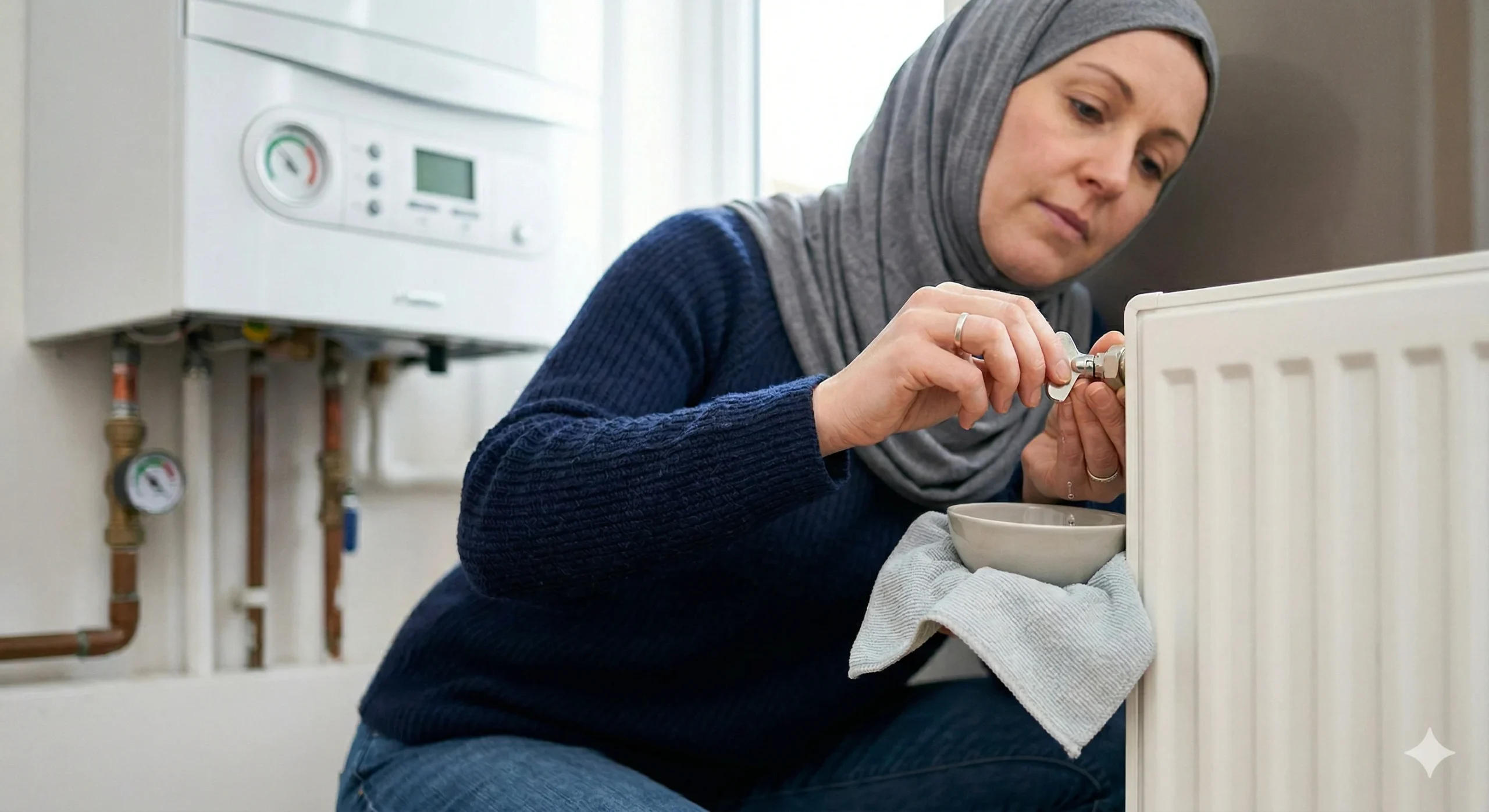
Bleeding a radiator is the safest, most controlled way to drain water from a central heating system. Choose a convenient downstairs radiator (as water settles at the bottom of the system). Place an old, thick towel on the floor and hold a washing-up bowl directly underneath the bleed valve (the small square nut usually located at the top right or left of the radiator panel).
3. Release the Water
Insert your radiator bleed key into the square valve and turn it very slowly anti-clockwise. Initially, you might hear a sharp hiss of trapped air escaping, which will quickly be followed by a solid stream of water. Allow the water to bleed steadily into the bowl.
If the water coming out is pitch black or resembles thick sludge, your system is heavily corroded, much like the mineral buildup we discuss when explaining how to clean a washing machine drum, and requires a professional power flush to clear the debris.
4. Check the Gauge
After bleeding roughly one to two pints of water into the bowl, close the radiator valve tightly by turning the key clockwise. Walk back to the boiler and check the pressure gauge. If the needle has dropped back into the green 1.0 to 1.5 bar range, you are finished. If it is still sitting at 2.0 bar or higher, go back to the radiator and bleed a little more water until the correct baseline is reached.
What if the Pressure Keeps Rising? (When to Call a Pro)
If you bleed the pressure down to 1.5 bar, but you wake up the next morning and find the gauge has crept back up to 3.0 bar, you are no longer dealing with a simple overfill. You have a mechanical failure inside the boiler casing.
There are two highly likely culprits:
- A Faulty Pressure Relief Valve (PRV): The valve designed to vent excess pressure has become stuck or blocked with system sludge, preventing it from regulating the water load.
- A Damaged Expansion Vessel: Inside the boiler is a small tank with a rubber diaphragm. This tank absorbs the expanding hot water. If the rubber diaphragm perishes or splits, the water has nowhere to expand into, causing the pressure gauge to spike violently every time the heating turns on.
As a homeowner, you cannot legally or safely open the main casing of the boiler to replace these internal components. You must contact a fully qualified, Gas Safe registered engineer for a professional diagnosis and repair.
FAQs on High Boiler Pressure
Is high boiler pressure dangerous? Will it explode? No, your boiler will not explode. Modern boilers are fitted with a highly sensitive safety mechanism called a Pressure Relief Valve (PRV). If the internal pressure hits 3.0 bar, the PRV automatically opens and dumps the excess water safely outside your house through a small copper blow-off pipe. Your boiler will also initiate an automatic lock-out, shutting itself down to prevent any damage to the heat exchanger.
Can I drain water directly from the boiler instead of a radiator? You can, but only if your specific plumbing setup has a dedicated drain-off valve fitted to the pipework directly beneath the boiler. Opening a drain-off valve with a hosepipe is faster, but for most homeowners, simply bleeding a radiator is far safer, requires less specialized equipment, and is significantly less messy.
Managing your boiler pressure is simply an exercise in balancing water volume. By ensuring your filling loop is tightly closed and slowly bleeding out the excess water, you can stabilize the system and get your central heating back up and running efficiently in minutes.