







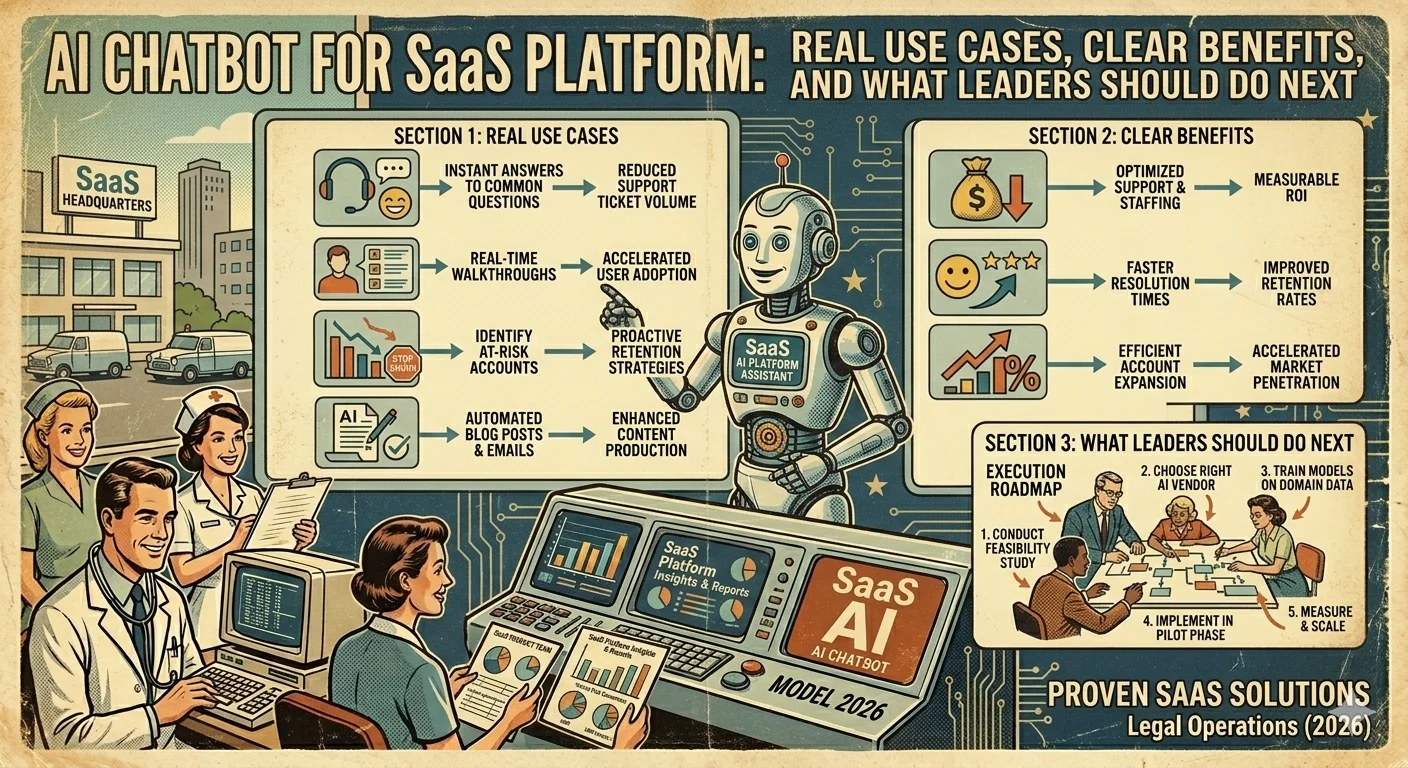
If you run a SaaS company, you already know AI is on the table. The real decision is where to plug it in so it drives measurable impact.
The pressure is real. Customer expectations are rising. Support tickets grow as user bases grow. Sales teams want better leads. Product teams want sharper insight into what users actually do inside the app. At the same time, hiring more people every quarter is not a long-term answer.
This is where an AI chatbot for a SaaS platform becomes practical, not experimental. Not a toy on the website. Not a shiny feature for a launch deck. A working system that answers users, routes problems, collects signals, and feeds insight back into the business. Let’s look at what this really means for SaaS companies and how leaders should think about it.
The Real Problem SaaS Leaders Are Facing
SaaS is built on recurring revenue. That means retention matters more than acquisition hype.
- If customers do not get value fast, they leave.
- If support is slow, they get frustrated.
- If onboarding is confusing, they never fully adopt the product.
Each of these leaks revenue quietly.
Most teams try to fix this by hiring more support agents, more success managers, more SDRs. That works for a while. But costs rise faster than revenue if nothing changes in the model.
An AI chatbot for business gives SaaS leaders a different lever. It helps manage growing demand without adding the same pace of headcount.
But it has to be done right.
What an AI Chatbot Really Does Inside a SaaS Product
When people hear chatbots, they often think of a basic FAQ tool. That is outdated thinking.
A modern SaaS chatbot works across the customer journey:
- Answers product questions inside the app.
- Guides new users during onboarding.
- Handles routine support tickets.
- Routes complex issues to the right human team.
- Collects intent data from conversations.
- Flags churn risk based on user behavior and sentiment.
In short, it sits between your users and your internal teams and keeps both sides moving smoothly. For SaaS companies, this is not about novelty. It is about control. Control over response time. Control over customer experience. Control over cost.
Core Benefits That Matter to Executives
1. Faster Support Without Hiring More Agents
As the customer base grows, support tickets rise too. An AI chatbot for SaaS companies handles everyday queries such as password recovery, billing help, feature details, and basic troubleshooting steps. Instead of waiting hours for a reply, users get answers in seconds. This improves satisfaction and reduces ticket backlog at the same time.
2. Better Onboarding and Activation
Most churn starts early. Users sign up but never reach the moment where they see real value. A saas ai chatbot can guide users step by step inside the product. It can prompt them to complete setup tasks, explain features in simple language, and suggest next actions based on behavior. This shortens the time to value and improves activation rates.
3. Smarter Sales and Lead Qualification
Many website visitors have doubts before they book a demo. A SaaS chatbot asks smart questions about company size, needs, and budget. It sends serious buyers to sales right away. Your team then focuses on ready prospects instead of casual visitors.
4. Clearer Product Insight
Every chatbot conversation is data. You learn what users struggle with. You see which features confuse them. You notice patterns in complaints. Over time, this becomes a feedback engine that helps product teams decide what to fix or improve next.
How AI Chatbots Improve SaaS Customer Retention
Retention is not magic. It is the result of small daily interactions. It comes down to consistent daily support. When users get quick answers, timely guidance, and help inside the app, they build trust, use more features, and are far less likely to leave.
How AI chatbots improve SaaS customer retention comes down to three things:
- Immediate Help
Users get clear answers in seconds, day or night. No waiting in queues. Fast replies reduce frustration and keep product momentum strong. - Proactive Guidance
The chatbot nudges users when activity drops or when steps remain incomplete. Timely prompts help them finish setup and discover key features. - Early Warning Signals
When users often ask about cancellations, pricing, or feature gaps, alerts are triggered. Success teams respond quickly and prevent churn before it starts.
Retention is not saved by one big campaign. It is saved by consistent micro interactions. A well-built AI chatbot for a SaaS platform makes those interactions automatic and reliable.
Real Use Cases Inside SaaS Businesses
Let’s make this practical.
In Customer Support
- Auto responses for common tickets.
- Intelligent routing to the right support tier.
- Knowledge base suggestions based on user queries.
- Status updates for open issues.
This reduces average resolution time and increases first contact resolution rates.
In Sales and Marketing
- Website chat that books demos instantly.
- Lead scoring based on answers given in chat.
- Personalized content suggestions.
- Follow-up emails triggered by chatbot conversations.
This tightens the loop between marketing spend and sales output.
In Product
- In-app guidance during onboarding.
- Feature discovery prompts.
- Feedback collection through conversational surveys.
- Insight dashboards built from chat data.
This turns everyday questions into product intelligence.
Choosing the Right AI Chatbot for a SaaS Platform
Not every tool fits every SaaS model. Leaders should look at four things:
- Integration with your CRM, helpdesk, and product analytics.
- Ability to train on your own knowledge base and product data.
- Clear analytics on conversations, resolution rates, and user sentiment.
- Security and compliance controls, especially for B2B SaaS.
If the chatbot works in isolation, it will not deliver full value.
Platforms to Consider
When evaluating options, it helps to look at platforms built with SaaS use cases in mind.
- GetMyAI: The Unified AI Agent Platform for SaaS
It helps SaaS companies build and manage AI agents from one Dashboard. It supports websites, WordPress, WhatsApp, Instagram, Slack, and Telegram. Teams can train agents using PDFs, documents, and knowledge bases. The Activity and Analytics sections help improve answers over time. It is built for clear control, simple deployment, and steady performance growth.
- Drift: The Revenue Acceleration Platform
This helps SaaS companies turn website visitors into sales meetings faster. It connects with tools like Salesforce and HubSpot to spot serious buyers in real time. Rather than asking users to fill out long forms, visitors can book meetings in seconds. Drift behaves like a virtual sales rep, connecting ready buyers with your team and shortening the sales process.
- Fini Labs: The Accuracy-Focused Automation Tool
Fini Labs is built for SaaS teams that need very accurate answers. It focuses on reducing mistakes and handling complex problems step by step. It can turn knowledge bases and Slack content into workflows that complete tasks, not just show links. This makes it useful for technical products where precision and reliability matter most.
- Intercom Fin AI Agent: The Product-Led Support Engine
Works best for SaaS companies that build support into their product experience. It finds information inside help centers, PDFs, and developer documents. It supports users during workflows and can also understand screenshots. If the issue is too advanced, it transfers the chat to a human with complete context, so the experience stays smooth and joined.
- Zendesk AI: The Enterprise Support System
Built for large SaaS companies that manage heavy ticket flow. It classifies and routes requests automatically using intent and sentiment signals. It also assists agents by summarizing chats and recommending replies. With detailed reporting tools, it allows leadership to monitor performance and improve support efficiency across growing teams.
Each platform approaches the problem differently. The key is alignment with your growth model and internal processes.
Common Mistakes Leaders Should Avoid
Even good tools fail if the rollout is weak.
Here are patterns that hurt results:
- Treating the chatbot as a side project owned only by support.
- Launching without proper training data.
- Not updating the knowledge base regularly.
- Ignoring analytics after deployment.
- Over-automating without clear escalation to humans.
An AI chatbot for SaaS companies must be built into the main product and revenue strategy, not handled like a small experiment.
Leaders should judge chatbot success by business impact, not surface metrics. Track faster response time, fewer tickets per active user, higher activation, stronger feature use, lower churn among chatbot users, and revenue from chatbot-qualified leads. If results do not connect to retention, revenue, or cost control, the setup needs work.
Growth in SaaS is about removing friction. Delayed replies, long queues, and unclear onboarding hurt trust. A strong AI chatbot for a SaaS platform reduces that friction and frees teams to handle complex, high-value work.
Conclusion: AI Chatbots as a Long-Term SaaS Investment
The conversation around AI is often filled with hype. But the real value is simple. An AI chatbot for a SaaS platform gives you faster support, better onboarding, smarter sales qualification, and clearer product insight. It strengthens retention by improving daily user interactions. It controls support costs while improving response quality.
For businesses focused on recurring revenue, that combination is powerful. It is no longer about deciding if chat automation makes sense. It is about how quickly you can add it to your product and link it to measurable business results. Leaders who treat chat as core infrastructure, not a website accessory, will notice stronger customer satisfaction, retention, and revenue growth.