







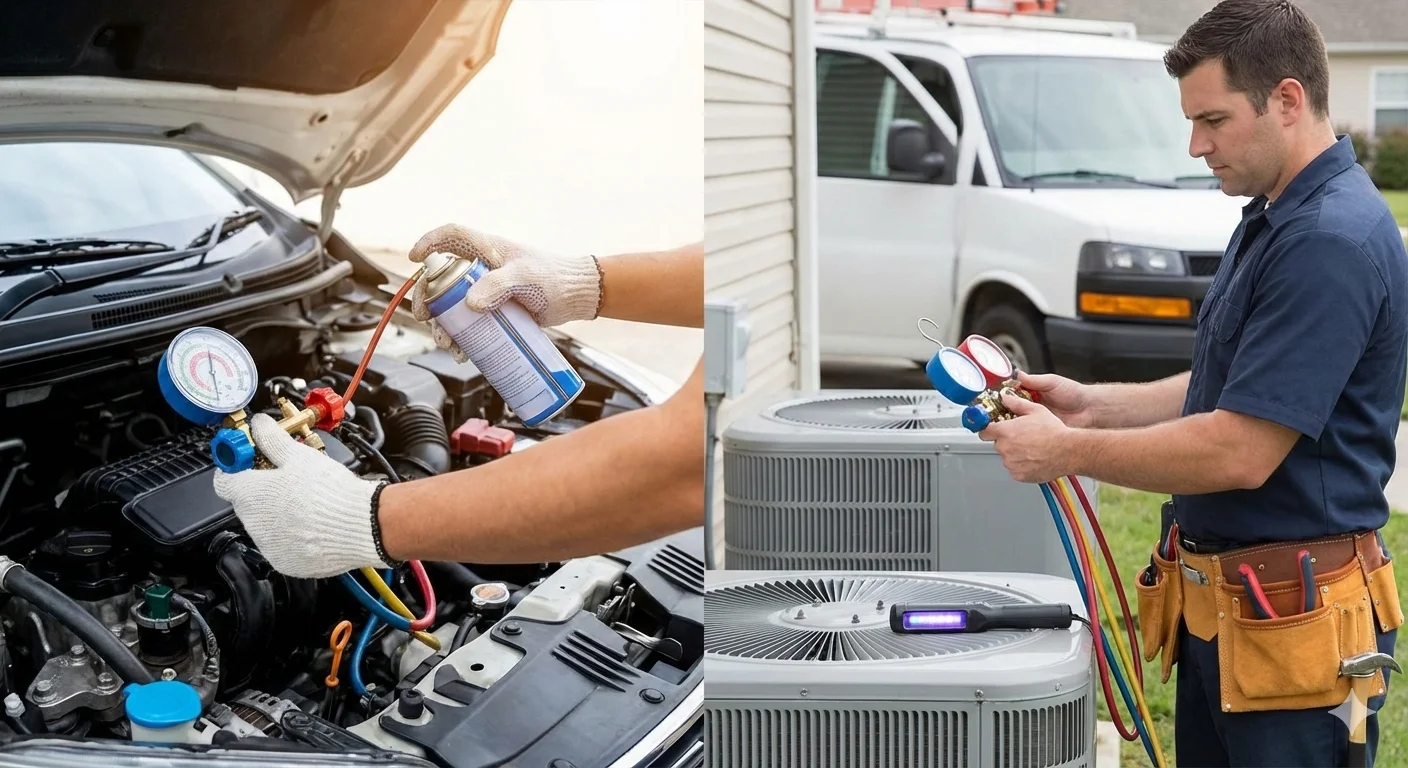
There is nothing worse than turning on your air conditioner on a sweltering summer day, expecting a cool breeze, and getting a blast of hot, humid air instead. Whether it is the vents in your dashboard or the registers in your ceiling, a refrigerant leak is the number one enemy of a cooling system.
However, the approach to a fix leak in ac system varies drastically depending on whether you are dealing with a vehicle or a residential HVAC unit. While a car AC leak can often be patched with a $30 DIY kit, a home system usually requires professional brazing and EPA-certified handling.
This guide breaks down the symptoms of a leak, how to find it, and the specific repair methods for both automotive and home systems.
Signs You Have a Refrigerant Leak
Before you buy tools or call a mechanic, you need to confirm that a leak is actually the problem. A system can fail for many reasons, such as a bad compressor or a broken fan.
Common Symptoms:
- Warm Air: The most obvious sign. If the air is room temperature, the refrigerant (the substance that absorbs heat) is likely gone. You should check why is my ac blowing hot air to rule out electrical issues like a tripped breaker or bad capacitor first.
- Hissing Sounds: A large leak will often produce an audible hiss as the high-pressure gas escapes.
- Frozen Coils: Ironically, low refrigerant causes the pressure to drop, which makes the remaining fluid get too cold, freezing the moisture in the air into a block of ice on your evaporator coils.
- Sky-High Energy Bills: A system low on refrigerant has to run constantly to try and reach the target temperature. If you are asking why is my electric bill so high, a slow leak in your home AC is a prime suspect.
How to Fix Leak in AC System Car (DIY Methods)
Automotive systems use rubber hoses and O-rings that dry out and crack due to engine heat and vibration. Because of this, many car owners search for how to fix a leak in your car ac system hoping for a quick driveway repair.
1. The “Recharge & Seal” Kit (Easiest) For small pinhole leaks in rubber components, “AC Stop Leak” products can work.
- The Process: You buy a can of R-134a (or R-1234yf for newer cars) that contains a leak sealant additive. You connect it to the low-pressure port, start the engine, and fill the system. The sealant swells the rubber O-rings to stop the gas from escaping.
- The Risk: These sealants can sometimes “gunk up” expensive components like the compressor or expansion valve. Use them only as a last resort for older vehicles.
2. Replacing Schrader Valves (Common) Often, the leak isn’t in a hose at all, but in the charging ports themselves. The “Schrader valves” look just like tire valve stems. If you see bubbling around the service ports, you can use a valve core tool to tighten or replace them for under $10.
3. Condenser Replacement The condenser sits at the very front of the car and often gets hit by rocks. If a rock punctures it, no amount of “stop leak” will fix it. You must unbolt the damaged part and install a new one.
Fix Leak in Home AC System (Why You Call a Pro)
When it comes to residential units, the query fix leak in home ac system usually leads to a different answer: Call a professional.
Why Home AC is Different:
- Copper Lines: Home systems use rigid copper tubing. Leaks here are usually caused by corrosion (formicary corrosion) or vibration cracks. You cannot use rubber sealants effectively on copper.
- Brazing Required: To fix a copper leak, the area must be sanded down and brazed (welded) with a silver-solder alloy at high heat.
- Legal Restrictions: Handling home refrigerants (like R-22 or R-410A) typically requires an EPA Section 608 certification. Venting these gases into the atmosphere is illegal.
The “Top Off” Myth: Many homeowners ask a technician to just “add a little Freon” to get them through the summer. This is a waste of money. The system is a sealed loop; if it needs gas, there is a hole. Unless you fix the hole, that expensive refrigerant will leak right back out in a few weeks.
How to Fix a Refrigerant Leak: Detection Tools
You cannot patch a hole you cannot see. Whether you are working on a car or inspecting your home unit, finding the exact spot of the freon leak in ac system is the hardest part.
1. UV Dye Test This is the gold standard. A special fluorescent dye is injected into the system. You run the AC for a few days, then shine a UV (black light) flashlight over the engine bay or coil. The leak will glow bright green or yellow.
2. Electronic “Sniffers” Professionals use handheld devices that beep rapidly when they detect halogen gases. These are excellent for finding leaks in the evaporator coil buried deep inside your dashboard or furnace, where you can’t see with a flashlight.
3. The Soap Bubble Method For a low-tech DIY solution, mix water and dish soap in a spray bottle. Spray the fittings, valves, and connections. If you see bubbles forming and growing, you have found your leak.
Conclusion
Learning how to fix leak in ac system car issues can save you hundreds of dollars if the problem is just a dried-out O-ring or a loose valve. However, for home systems, the wiser choice is usually to hire a pro to braze the line or replace the leaking coil. In either case, ignoring the leak is not an option—running a compressor with low refrigerant will eventually destroy the heart of your system, turning a repairable leak into a total system replacement.